Table of Contents
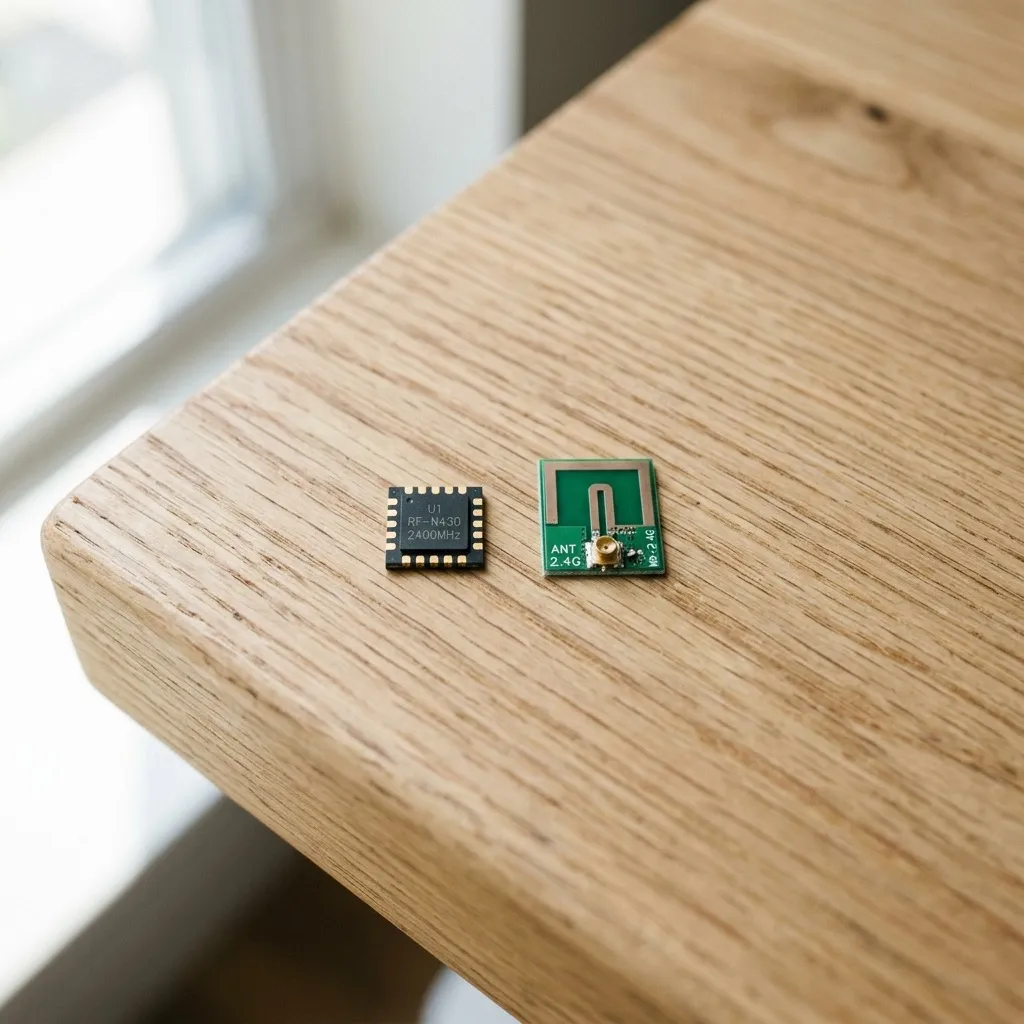
A Wi-Fi 7 access point contains more RF content than the entire 4G smartphone of five years ago. The 6 GHz band alone requires new filters, new power amplifiers, and new antenna switch paths that simply didn’t exist in Wi-Fi 6 designs. And the supply base that makes those RF components—the GaAs fabs, the SAW filter lines, the advanced packaging houses—is the least elastic part of the entire semiconductor industry.
📌 Direct Answer: The RF semiconductor supply chain in 2026 is defined by process specialization and supplier concentration. GaAs HBT power amplifiers—used in every Wi-Fi and 5G transmit chain—are fabricated primarily at Skyworks' Newbury Park and Woburn fabs, Qorvo's Greensboro and Hillsboro fabs, and Win Semiconductors (Taiwan), the world's largest GaAs foundry. SAW/BAW filters—the frequency-selective components that define band edges—are produced at Murata (Japan), Taiyo Yuden (Japan), Qorvo (USA, BAW), Broadcom (USA, FBAR-BAW), and Skyworks (USA, SAW). This is the entire global supply base for smartphone-grade acoustic filters. The lead times for RF components reflect this concentration: 28-36 weeks for Broadcom Wi-Fi 7 enterprise chipsets, 20-28 weeks for Qualcomm RFFE modules, and 18-24 weeks for SAW/BAW filters. For procurement teams, the strategic priority is qualifying second sources for RF components before the design is frozen—once a specific SAW filter or PA is designed into the PCB layout and the impedance matching network is tuned, changing suppliers requires a full RF redesign.
Related Reading: For industrial IoT wireless connectivity, see Industrial IoT Semiconductor Sourcing 2026. For Ethernet PHY (wired connectivity), see Global Ethernet PHY Chip Market by Region 2026. This article is the first dedicated RF and wireless connectivity procurement guide on supplyics.com.
Wi-Fi 7 Chipset Procurement: The 2026 Transition Year
Wi-Fi 7 (IEEE 802.11be) brings 320 MHz channel bandwidth (doubled from Wi-Fi 6E’s 160 MHz), 4K QAM modulation (up from 1K QAM), and Multi-Link Operation (MLO)—the ability to simultaneously transmit and receive on multiple frequency bands. The practical benefit: theoretical maximum throughput of 46 Gbps (vs. 9.6 Gbps for Wi-Fi 6E), and—more importantly for real-world use—latency reduction through MLO.
Wi-Fi 7 Chipset Supplier Landscape
| Supplier | Client (Smartphone/PC) | Enterprise AP / Router | IoT/Embedded | Lead Time | Key Strength |
|---|---|---|---|---|---|
| Qualcomm | FastConnect 7900 (phone), NCM865 (PC module) | Networking Pro 1620 series, IPQ9574 | QCC207x IoT | 16-22 wks (client), 20-28 wks (AP) | Market leader; integrated with Snapdragon ecosystem |
| Broadcom | BCM4398 client | BCM4916/BCM6726 AP | BCM4375 IoT | 26-36 wks (AP), 20-28 wks (client) | Enterprise AP market leader; FBAR filters integrated on-chip |
| MediaTek | Filogic 680 (phone) | Filogic 880 (AP/router) | Filogic 380 IoT | 14-20 wks | Best lead times; aggressive pricing (15-25% below Qualcomm) |
| Intel | BE200 client (PC, CNVi) | N/A | N/A | 12-16 wks | Integrated into Intel Evo platform; direct Intel distribution |
| MaxLinear | N/A | Panther Creek series | N/A | 18-24 wks | Service provider gateway market specialist |
| Realtek | RTL8922 | RTL8932 | RTL8920 IoT | 12-18 wks | Cost leader; shortest lead times; emerging enterprise presence |
Procurement guidance:
For enterprise AP/router designs, Broadcom’s BCM4916/BCM6726 series is the performance leader—but 26-36 week lead times and strong allocation to the largest networking OEMs (Cisco, Aruba, Ruckus) make Broadcom Wi-Fi 7 difficult to access for smaller OEMs. MediaTek’s Filogic 880 is the pragmatic alternative: 14-20 week lead times, 15-25% lower pricing, and performance that benchmarks within 5-10% of Broadcom for most real-world workloads.
For IoT/embedded designs, the competitive dynamics are different. Wi-Fi 7 in IoT is still a niche—most IoT devices shipping in 2026 use Wi-Fi 6 or Wi-Fi 4 (802.11n). The transition to Wi-Fi 7 in IoT will be slower than in smartphones or enterprise APs, and for most IoT procurement teams, the priority should be securing Wi-Fi 6E supply (which is adequate for IoT throughput requirements) rather than chasing Wi-Fi 7.
5G mmWave Infrastructure: A Shrinking Opportunity for Non-Huawei Suppliers
The 5G mmWave (24-47 GHz) infrastructure market that was projected to drive massive RF component demand has not materialized at the scale that was forecast in 2022. Excluding China (where Huawei uses its in-house mmWave RF ICs), the merchant market for 5G mmWave RFFE components is relatively small in 2026—estimated at $800 million to $1.2 billion in total component revenue.
The primary suppliers of 5G mmWave RF front-end modules for infrastructure are:
- Analog Devices (ADMV-series beamforming ICs, acquired from Anokiwave IP)
- Qorvo (GaN-on-SiC PAs for mmWave base stations, primarily serving the Ericsson/Nokia supply chain)
- NXP (mmWave FEMs, primarily serving the Samsung Networks and European infrastructure OEM supply chain)
For procurement teams sourcing 5G infrastructure components, the mmWave RF supply base is narrow but demand is also constrained—lead times of 18-26 weeks are typical, and allocation is not the crisis it was in 2024-2025 when mmWave infrastructure buildout forecasts were higher.
Multi-Protocol IoT Wireless SoCs: The Consolidation Trend
The IoT wireless SoC market is consolidating around a single value proposition: one chip that supports all the protocols a typical IoT device needs—Bluetooth LE, Thread, Matter, Zigbee, and in some cases Wi-Fi—with a common software development environment.
Leading Multi-Protocol IoT SoCs in 2026
| Supplier | Device | Protocols | Core | Key Feature | Lead Time | Price (10ku) |
|---|---|---|---|---|---|---|
| Nordic | nRF54L15 | BLE 6.0, Thread, Matter, Zigbee | Cortex-M33 (128MHz) | Best power efficiency; 1.5µA sleep | 12-18 wks | $1.50-2.20 |
| Silicon Labs | MG26 | BLE 6.0, Thread, Matter, Zigbee | Cortex-M33 (78MHz) | Strongest Matter implementation; Secure Vault security | 14-20 wks | $2.00-3.00 |
| TI | CC2674R10 | BLE 6.0, Thread, Matter, Zigbee | Cortex-M33 (96MHz) | Best multi-protocol coexistence; integrated PA | 16-22 wks | $2.20-3.20 |
| Espressif | ESP32-C6 | Wi-Fi 6, BLE 5.4, Thread, Zigbee | RISC-V (160MHz) | Lowest cost; RISC-V architecture | 8-14 wks | $1.20-1.80 |
| NXP | RW612 | Wi-Fi 6, BLE 6.0, Thread, Matter | Cortex-M33 (260MHz) | Highest performance; integrated tri-radio | 18-24 wks | $3.50-5.00 |
Procurement guidance:
For cost-sensitive IoT products (smart home sensors, beacons, tags), Espressif’s ESP32-C6 has become the default choice—it is the only sub-$2 multi-protocol SoC on the market, and lead times of 8-14 weeks are the best in the industry. The RISC-V architecture has not been a barrier to adoption; Espressif’s ESP-IDF development framework abstracts the CPU architecture effectively.
For industrial and commercial IoT products where reliability, security certification, and multi-year lifecycle commitment matter more than unit cost, Nordic’s nRF54L15 is the market leader. Nordic has the best track record of sustaining product availability (the nRF51 and nRF52 families have been in production for 8+ and 6+ years respectively) and the most power-efficient BLE implementation in the industry.
The SAW/BAW Filter Bottleneck
Acoustic filters (SAW and BAW) are the least appreciated supply chain risk in wireless product procurement. These seemingly commodity components—a filter is a $0.10-0.50 component in a smartphone—are fabricated at only 4-6 fabs worldwide that can produce filters meeting the performance specifications for Wi-Fi 6E/7 and 5G bands.
| Filter Technology | Typical Use | Key Suppliers | Fab Locations | Supply Risk |
|---|---|---|---|---|
| SAW (Surface Acoustic Wave) | Sub-2.5 GHz bands (Wi-Fi 2.4GHz, cellular low/mid bands) | Murata, Taiyo Yuden, Skyworks, Kyocera | Japan (Murata, Taiyo Yuden), USA (Skyworks) | 🟡 Medium—more suppliers, more fab locations than BAW |
| BAW (Bulk Acoustic Wave) | 2.5-7 GHz bands (Wi-Fi 5/6 GHz, cellular n77/n79) | Qorvo (BAW), Broadcom (FBAR-BAW), Skyworks (BAW) | USA (Qorvo FL, Broadcom CO, Skyworks CA) | 🔴 High—only 3 suppliers globally, all USA-based fabs |
| TC-SAW (Temperature-Compensated SAW) | Cellular bands requiring tight temperature stability | Murata, Taiyo Yuden, Skyworks | Japan, USA | 🟡 Medium |
The BAW filter supply concentration matters because every Wi-Fi 6E/7 device needs BAW filters for the 6 GHz band. A Wi-Fi 7 smartphone contains 4-8 BAW filters for the 6 GHz Wi-Fi band alone, plus additional BAW filters for 5G n77/n79. The three BAW filter suppliers (Qorvo, Broadcom, Skyworks) cannot expand capacity quickly because the specialized piezoelectric material deposition equipment used in BAW filter fabrication has limited tool availability and long lead times.
For procurement, the practical implication: if your product uses Wi-Fi 6E or 7, the BAW filters in your RF front-end are the component with the highest geographic supply concentration (all three BAW filter fabs are in the United States, making the supply chain vulnerable to export controls, natural disasters, or trade disputes) and the longest capacity expansion timeline. Maintain higher buffer inventory of BAW filters than for other RF components.
SupplyICs sources RF and wireless connectivity ICs across all major suppliers—Qualcomm, Broadcom, MediaTek, NXP, Nordic, Silicon Labs, TI, Skyworks, Qorvo, and Murata—with full lot traceability and anti-counterfeit verification. Contact our RF procurement desk for same-day pricing and availability on Wi-Fi 7 chipsets, UWB controllers, or multi-protocol IoT SoCs.
Frequently Asked Questions (FAQ)
What are the main RF front-end components that procurement teams need to source for wireless products?
An RF front-end (RFFE) for a modern wireless product contains four component categories: (1) Power Amplifiers (PAs)—typically GaAs HBT or GaN HEMT for Wi-Fi 6E/7 and 5G, amplifying the transmit signal to the required output power; (2) Low-Noise Amplifiers (LNAs)—improving receiver sensitivity, often integrated into FEMs; (3) Switches and Multiplexers—SOI (Silicon-on-Insulator) switches routing between antennas and frequency bands; and (4) Filters—SAW (Surface Acoustic Wave) or BAW (Bulk Acoustic Wave) for band selection, increasingly complex as Wi-Fi 7 adds 6 GHz band and 5G adds n77/n79 bands. These components are increasingly integrated into Front-End Modules (FEMs) that combine PA+LNA+Switch+Filter in a single package from Qualcomm, Broadcom, Skyworks, Qorvo, or Murata. For procurement, the key insight is that RF components use specialized process technologies (GaAs, SOI, SAW/BAW) fabricated at a small number of specialized fabs globally—making RF supply chains more concentrated and less elastic than digital CMOS supply chains.
Who are the leading Wi-Fi 7 chipset suppliers in 2026 and what are the lead times?
The Wi-Fi 7 (802.11be) chipset market in 2026 is led by Qualcomm (FastConnect 7900, integrated into Snapdragon 8 Gen 4 platforms; Networking Pro 1620 for enterprise APs), Broadcom (BCM4398 client, BCM4916 enterprise AP), MediaTek (Filogic 680 for smartphones, Filogic 880 for APs/routers), and MaxLinear (primarily service provider gateway market). Lead times vary significantly: Qualcomm Wi-Fi 7 chipsets for smartphone platforms are 16-22 weeks; Broadcom enterprise AP chipsets are 26-36 weeks (constrained by advanced-node wafer allocation at TSMC N6/N5); MediaTek client Wi-Fi 7 chipsets are 14-20 weeks (MediaTek uses a mix of TSMC and UMC, providing better capacity elasticity). Intel's BE200 Wi-Fi 7 client module (shipping in Intel Evo platform notebooks) is available through Intel's direct distribution channel at 12-16 week lead times.
What is UWB (Ultra-Wideband) and which suppliers provide UWB chipsets?
UWB (Ultra-Wideband) is a short-range wireless technology (IEEE 802.15.4z) that provides centimeter-level positioning accuracy through time-of-flight measurement of nanosecond-duration pulses across 500 MHz of bandwidth (typically at 6-9 GHz). UWB is used for: precise indoor positioning (asset tracking, warehouse navigation), secure hands-free vehicle access (digital car key per CCC standard), and device-to-device ranging (Apple AirTag-like functionality). The UWB chipset market is dominated by three suppliers: NXP (Trimension series—SR150/SR250 for anchors/tags, NCJ29D5 for automotive secure car access), Qorvo (DW3000/DW4000 series—the original UWB chipset supplier, strong in industrial RTLS), and Apple (U1/U2 chips—integrated into iPhone and Apple Watch, not sold as standalone ICs to third parties). Lead times for NXP and Qorvo UWB chipsets are 14-22 weeks. UWB is a growing but still niche market—total UWB chipset shipments in 2026 are estimated at 300-400 million units, 90%+ of which are Apple (integrated) and NXP (merchant market leader).