Table of Contents
- Who Makes High-Speed Data Converters—and What’s Available?
- What Is Driving the High-Speed Converter Shortage?
- 1. Direct RF Sampling Is Displacing Superheterodyne Architectures
- 2. AI Data Center Optical Interconnects
- 3. ATE Capacity Is the Hidden Bottleneck
- What Are Your Sourcing Options When Allocation Runs Dry?
- Option 1: Functional Equivalent with PCB Layout Change
- Option 2: FPGA-Based Digital Downconversion with Lower-Speed ADC
- Option 3: Leverage Independent Distribution
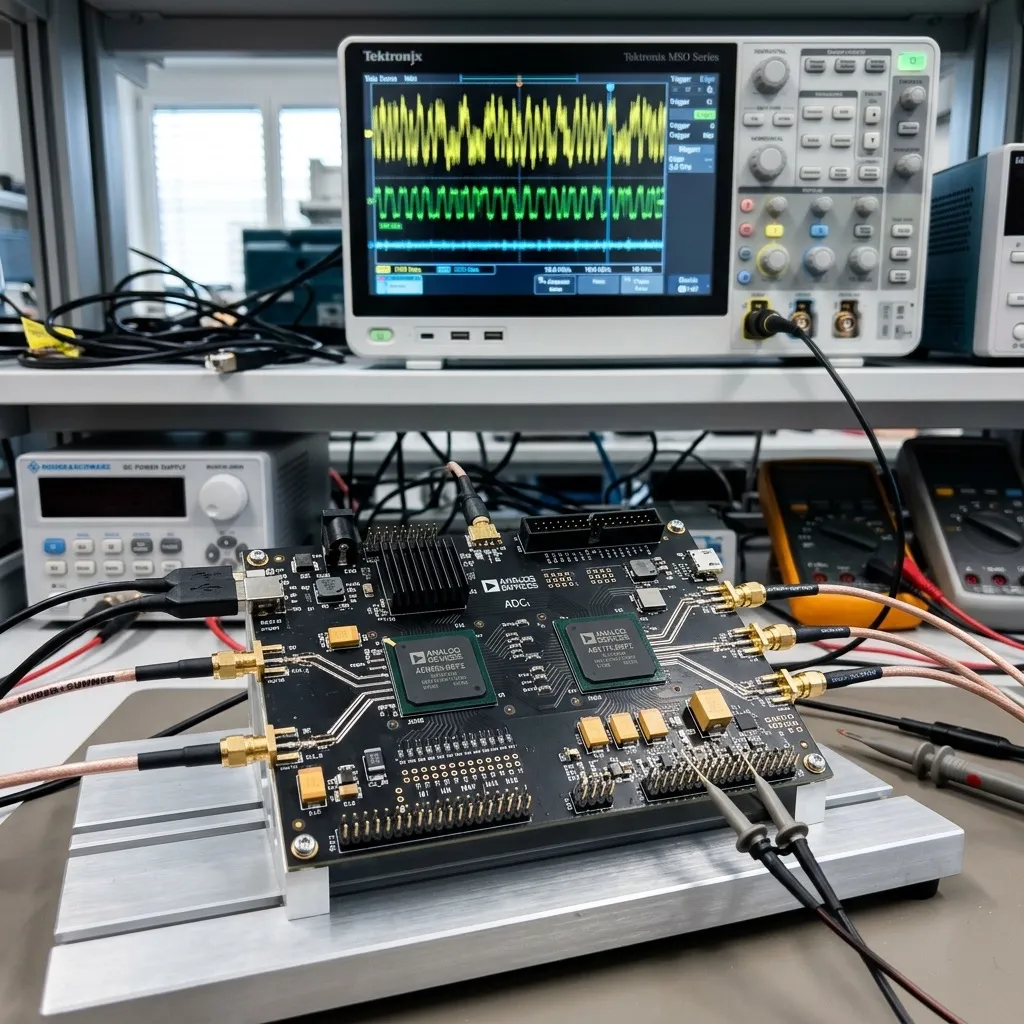
A high-speed analog-to-digital converter is not a commodity part. It is a precision mixed-signal device fabricated on a specialized BiCMOS or RF-SOI process that only a handful of fabs in the world can produce. Testing a 3 GSPS ADC requires a signal generator, clock source, and data capture system capable of operating at multi-GHz frequencies with femtosecond jitter—equipment that costs millions of dollars and has its own multi-month lead time.
In 2026, all three of the world’s dominant high-speed converter suppliers—Analog Devices, Texas Instruments, and Renesas—are quoting lead times that stretch past the point where a standard procurement buffer can absorb them. If your design uses a high-speed ADC or DAC and you don’t have confirmed allocation, your product schedule is at risk.
Who Makes High-Speed Data Converters—and What’s Available?
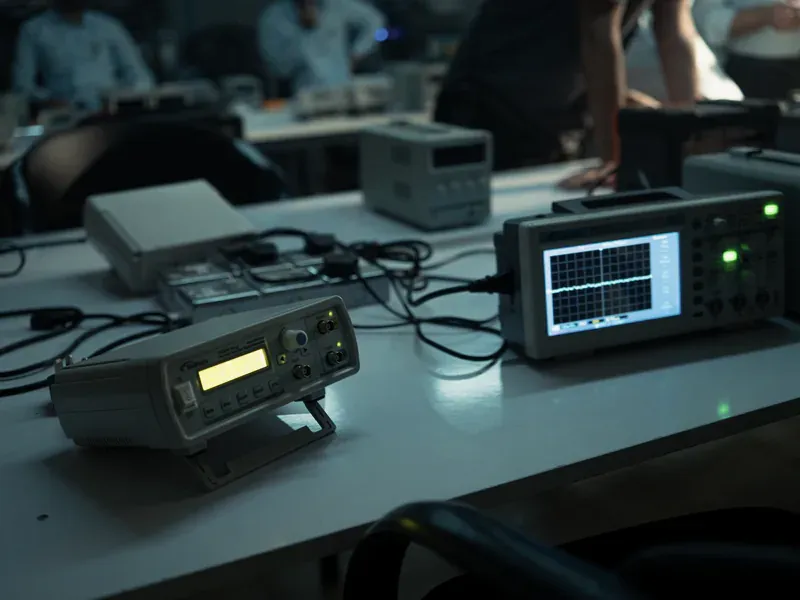
The supplier landscape for high-speed converters (≥1 GSPS) has consolidated significantly over the past decade through acquisitions:
| Supplier | Key High-Speed Product Families | Max Sample Rate | Lead Time (Jul 2026) | Fabrication Node |
|---|---|---|---|---|
| ADI | AD9680, AD9208, AD9213, AD9174 | 10 GSPS (AD9213) | 30–52 weeks | BiCMOS, 28nm–65nm |
| TI | ADC12DJ5200RF, ADC32RF45, DAC39RF10 | 10.4 GSPS (ADC12DJ5200RF) | 26–38 weeks | RF-SOI, 45nm–65nm |
| Renesas | ISLA214P50, ISLA222P25 | 500 MSPS–1.5 GSPS | 16–24 weeks | BiCMOS, 65nm–130nm |
| Maxim (ADI) | MAX5879, MAX19713 | 2.5 GSPS (DAC) | Absorbed into ADI lead times | BiCMOS |
| Microchip | MCP37D10, MCP37D20 | 200–500 MSPS | 12–20 weeks | CMOS, 130nm |
Key insight: Renesas is the dark horse for supply-constrained designs. Their high-speed converter portfolio (inherited from Intersil) has shorter lead times and less allocation pressure than ADI or TI—but with narrower product selection. For applications requiring 500 MSPS–1.5 GSPS sampling, Renesas offers a credible alternative with faster delivery.
What Is Driving the High-Speed Converter Shortage?
1. Direct RF Sampling Is Displacing Superheterodyne Architectures
The architectural shift from superheterodyne (downconversion + IF sampling) to direct RF sampling (digitizing at the antenna) is the single largest driver of high-speed ADC demand. A 5G Massive MIMO base station with 64T64R antenna configuration requires 64 receive paths, each with a multi-GSPS ADC. The global 5G base station deployment count exceeded 8 million units in mid-2026 (GSMA Intelligence), and each new deployment consumes high-speed converter inventory.
2. AI Data Center Optical Interconnects
Every 800G and 1.6T optical transceiver used in AI data center interconnects contains high-speed DACs for modulator drive and ADCs for receiver equalization. With hyperscaler CapEx on AI infrastructure exceeding $250 billion in 2026, these transceivers are being deployed at unprecedented volumes—and each one contains 2–4 high-speed data converters.
3. ATE Capacity Is the Hidden Bottleneck
High-speed converter testing requires specialized automated test equipment (ATE) from Teradyne, Advantest, or Cohu capable of sourcing and measuring multi-GHz signals. Lead times for this ATE equipment are 30–40 weeks, creating a secondary bottleneck: even if a fab produces more converter wafers, there is not enough test capacity to process them. This is why high-speed converter lead times have not improved despite wafer capacity additions—the test bottleneck acts as a rate limiter.
What Are Your Sourcing Options When Allocation Runs Dry?
Option 1: Functional Equivalent with PCB Layout Change
Accept that a pin-compatible drop-in replacement does not exist for high-speed converters, and budget the 8–12 weeks for a PCB layout change. This is the most practical option for designs with sufficient margin in the development schedule.
Example: Replace ADI AD9680 (dual 14-bit, 1 GSPS) with TI ADC32RF45 (dual 14-bit, 3 GSPS). The TI part exceeds ADI’s sample rate spec (overdesign is acceptable), uses a JESD204B interface (compatible with most FPGA receivers), but requires a different pinout, clock distribution, and power supply sequencing. Budget 12 weeks for the transition.
Option 2: FPGA-Based Digital Downconversion with Lower-Speed ADC
Add an FPGA-based digital downconverter (DDC) between the RF front-end and a lower-speed, more readily available ADC. The superheterodyne architecture uses analog downconversion; the DDC architecture does it digitally, at the cost of FPGA resources and power consumption.
Trade-off: +$50–150 in FPGA cost and +3–5W power consumption vs. 16–24 week ADC lead time (vs. 30–52 weeks for the high-speed part you are replacing). This is a viable path for non-power-constrained applications.
Option 3: Leverage Independent Distribution
When franchise allocation is exhausted, the independent market can supply genuine, traceable high-speed converters—but quality controls are non-negotiable. Key requirements:
- Date code verification against manufacturer lot history
- X-Ray inspection for lead frame and wire bond integrity
- Electrical testing at the specified sample rate and input frequency
- Full chain-of-custody documentation back to the OCM
SupplyICs maintains an independent distribution network with AS6081-aligned quality controls for high-speed converters from ADI, TI, Renesas, and Microchip. Every converter undergoes electrical verification at rated sample rate before shipment.
Your high-speed data converter allocation is at risk? SupplyICs sources ADCs and DACs across all speed grades with full electrical verification. Submit an RFQ or upload your BOM.
Frequently Asked Questions (FAQ)
Which high-speed data converter product families have the longest lead times in 2026?
As of July 2026, ADI's AD9680/AD9650 families (14/16-bit, 125–1000 MSPS ADCs) are quoting 30–42 week lead times, with the AD9208 dual 3 GSPS ADC stretching to 52 weeks. TI's ADC12DJ5200RF and ADC32RF45 families are at 26–38 weeks, with the ADC12DJ5200RF showing the tightest supply due to its dominance in 5G direct RF sampling applications. Renesas (formerly Intersil) high-speed converters are at a more manageable 16–24 weeks but with smaller product breadth. The common thread: converters fabricated on BiCMOS and RF-SOI processes are suffering from the same mature-node capacity reallocation that is tightening standard logic and analog IC supply—but with the added constraint that high-speed converter test requires specialized ATE equipment that is itself in short supply.
How can I find a functionally equivalent alternative to a constrained high-speed ADC?
High-speed ADCs are not pin-compatible across vendors—a direct footprint replacement is rare. However, functional equivalents with similar specifications (sample rate, resolution, input bandwidth, SFDR) often exist from competing vendors. The qualification path: (1) identify the three most critical specifications for your application (usually sample rate, input bandwidth, and SFDR at the target input frequency); (2) search for converters from alternative vendors that meet or exceed these specs; (3) evaluate whether the alternative's digital interface (JESD204B/C vs. LVDS parallel) is compatible with your FPGA/ASIC receiver; (4) budget 8–12 weeks for a PCB layout change accommodating different pinouts and 12–16 weeks for full system re-qualification. SupplyICs' cross-reference database covers over 15,000 high-speed data converters.
Should I redesign for Direct RF Sampling to reduce BOM complexity?
Direct RF sampling (digitizing the RF signal at the antenna without analog downconversion) eliminates mixers, LO synthesizers, and IF amplifiers from the BOM—reducing component count by 30–50%. However, it requires an ADC capable of sampling at 3+ GSPS with >8 GHz input bandwidth, which are exactly the most supply-constrained converters in 2026. The procurement calculus: a direct-RF architecture reduces the number of constrained parts from 5–8 (mixer, LO, IF amp, IF filter, IF ADC) to 1 (the RF ADC)—but that single part is harder to source than any of the individual parts it replaces. For new designs in 2026, the reduced BOM complexity of direct RF sampling is compelling, but only if you can secure guaranteed allocation for the RF ADC before committing to the architecture.