Table of Contents
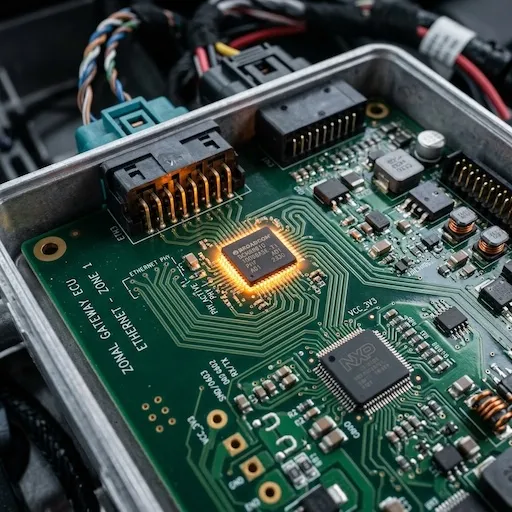
Automotive network backbones have transitioned rapidly into high-speed, Time-Sensitive Networking (TSN) Ethernet environments. In zonal architectures, gateway nodes aggregate local CAN-FD and LIN data and stream it across high-speed links to the central compute brain. The hardware block responsible for translating these digital streams onto the physical copper wire is the Automotive Ethernet Physical Layer (PHY) transceiver.
Selecting and sourcing these chips in 2026 requires understanding the physical constraints, electromagnetic compatibility (EMC) requirements, and the technical profiles of the market-leading transceiver options.
Selection Parameters for Zonal Automotive Ethernet PHYs
Unlike consumer Ethernet transceivers that run on heavy 4-pair Cat5e cabling, automotive PHYs utilize a single Unshielded Twisted Pair (UTP). This reduces weight and wiring complexity by up to 50%, but concentrates severe electromagnetic interference (EMI) challenges onto the transceiver silicon.
When selecting an automotive Ethernet PHY, hardware architects must evaluate:
- EMC and Noise Immunity: The transceiver must operate reliably amidst the high-voltage noise generated by adjacent electric vehicle (EV) inverter modules and electric motors.
- Latency and Time Synchronization: Supporting IEEE 802.1AS time-synchronization is essential to prevent latency drift in safety-critical ADAS cameras and domain gateways.
- Low-Power Sleep Modes: To prevent battery drain when the vehicle is parked, the PHY must support advanced sleep modes (such as Open Alliance TC10 Wake-Up sleep protocols).
Comparing Marvell Brightlane vs. Broadcom BroadR-Reach
The two leading silicon portfolios in this domain are the Marvell Brightlane family and the Broadcom BroadR-Reach series. The table below compares the technical specifications of their primary zonal transceivers:
| PHY Platform | Manufacturer | IEEE Standard | Maximum Data Rate | Package Style |
|---|---|---|---|---|
| 88Q1112 | Marvell Brightlane | 100BASE-T1 (IEEE 802.3bw) | 100 Mbps | QFN-36 (6x6mm) |
| 88Q2112 | Marvell Brightlane | 1000BASE-T1 (IEEE 802.3bp) | 1000 Mbps (1 Gbps) | QFN-40 (6x6mm) |
| BCM89892 | Broadcom | 100BASE-T1 / 1000BASE-T1 | 1000 Mbps (1 Gbps) | QFN-48 (7x7mm) |
Marvell Brightlane: The Diagnostic Standard
Marvell’s 88Q2112 is highly favored for high-bandwidth ADAS gateway nodes. It incorporates advanced cable diagnostics (Time Domain Reflectometry, or TDR) that can pinpoint physical faults (opens, shorts, or connector damage) in the copper wiring harness down to the centimeter, enabling rapid maintenance and diagnostic reporting.
Broadcom BCM89892: The Integration Leader
Broadcom’s BCM89892 is a highly integrated dual-port PHY transceiver that reduces peripheral component count on the board. Its integrated low-dropout (LDO) regulators and filtering components simplify layout design, making it a robust option for space-constrained zonal gateways.
Securing Ethernet PHY Supply Chains and Quality Control
Because automotive PHYs operate in safety-critical communication loops, B2B buyers must partner with audited suppliers to prevent counterfeit or degraded transceivers from entering production lines:
- Strict Date-Code Tracking: Sourced transceivers must have verified original manufacturer date codes to ensure they comply with AEC-Q100 stress parameters. Aged stock that has been stored outside hermetic conditions is prone to oxidation on the packaging leads.
- Electrical Loopback Audits: Authentic transceivers are tested using digital loopback modes to verify receiver sensitivity and packet error rate (PER) specifications. Counterfeits or pull-offs exhibit high packet loss when tested under high-temperature cycles.
- Micro-Decapsulation Verification: Chemical acid testing is used to verify proprietary die layouts and manufacturer stamps, ensuring the inner silicon matches the original packaging description.
Conclusion
Building next-generation zonal gateways requires an uncompromising approach to Ethernet transceiver selection and sourcing. By establishing dual-sourced layouts between Marvell’s diagnostic-rich Brightlane transceivers and Broadcom’s highly integrated BroadR-Reach series, and enforcing rigorous independent testing, automotive OEMs can mitigate mature node bottlenecks, secure their production lines, and ensure long-term network reliability in 2026.
Frequently Asked Questions (FAQ)
What are the primary sourcing challenges for automotive Ethernet PHYs in 2026?
Automotive Ethernet PHYs from Marvell and Broadcom face rigid safety audits and EMC testing requirements. Sourcing requires strict date-code verification and original packaging verification to avoid field failures.