Table of Contents
In mid-2026, the high-volume mobile phone industry has fully transitioned to ultra-fast Universal Flash Storage (UFS 4.0) protocols. However, the B2B industrial IoT sector—ranging from rugged handheld logistics computers to vehicle telematics systems—remains deeply anchored to legacy multi-chip package memory standards: eMCP (embedded Multi-Chip Package) and eMMC (embedded MultiMediaCard).
For procurement officers managing legacy designs, securing a steady supply of these aging memory packages has become a major sourcing challenge. This article analyzes the technical causes of the current shortage and outlines strategic sourcing pathways for obsolete B2B memory.
Why is Legacy eMCP/eMMC Obsolescence Accelerating in 2026?
The semiconductor memory market is highly cyclical and driven primarily by high-volume consumer electronics. Because smartphones represent over 70% of mobile RAM and flash consumption, the production roadmaps of major manufacturers like Samsung, Micron, and SK Hynix are optimized for consumer cycles.
This presents two distinct bottlenecks for industrial IoT hardware builders:
- Fab Re-Tooling: Foundries are aggressively converting mature eMMC lines into advanced high-bandwidth memory (HBM3e/HBM4) and UFS nodes to capitalize on the massive generative AI infrastructure boom.
- Long Industrial Lifecycles: Rugged industrial devices (e.g., forklift computers, B2B medical tablets, marine tracking systems) have operational lifecycles spanning 7 to 15 years. Carmakers and telemetry designers cannot justify a expensive mainboard redesign just because a legacy $5 memory chip has been deprecated.
Sourcing and Cross-Referencing B2B eMCP and eMMC
An eMCP combines two distinct components inside one package: an eMMC flash controller for non-volatile storage, and an LPDDR dynamic RAM die for operational workspace. If the exact model number is EOL, sourcing teams must cross-reference physical package dimensions, ball configurations, interface speeds, and internal memory allocations.
The table below outlines key technical specifications of popular legacy eMCP modules that frequently face acute shortages:
| Part Number | Manufacturer | eMMC Size (Flash) | LPDDR Size (DRAM) | Package Footprint |
|---|---|---|---|---|
| 16EMCP08-EL3BT527 | Kingston | 16 GB (eMMC 5.1) | 8 Gb (LPDDR3) | FBGA-162 (11.5x13.0x1.0mm) |
| K4E2E304EE-AGCE | Samsung | N/A (LPDDR3 Die Only) | 8 Gb (LPDDR3) | FBGA-178 (11.0x11.5x1.0mm) |
| H9TQ17ADFTMCUR-KUM | SK Hynix | 16 GB (eMMC 5.0) | 16 Gb (LPDDR3) | FBGA-221 (11.5x13.0x1.0mm) |
Key Sourcing Considerations:
- Footprint and BGA Pitch: Swapping Kingston’s 16EMCP08-EL3BT527 for another model requires confirming the BGA pitch matches perfectly. A mismatch by even 0.1mm will prevent solder ball alignment on the PCB.
- Firmware Compatibility: Legacy mobile eMMC modules contain an internal controller that manages flash blocks and wear-leveling. The host SoC (System on Chip) must support the specific eMMC protocol version (e.g., eMMC 5.0 vs eMMC 5.1).
Strategic Sourcing and Quality Assurance for Obsolete Memory
Because memory chips represent a highly targeted segment for counterfeiters, sourcing legacy components from independent distributors requires rigorous auditing:
- Solder Joint Inspection: Confirm that sourced chips are original, unused parts rather than pull-offs from reclaimed consumer electronics. Re-balled memory chips have weakened structural characteristics and fail quickly under automotive or industrial heat cycles.
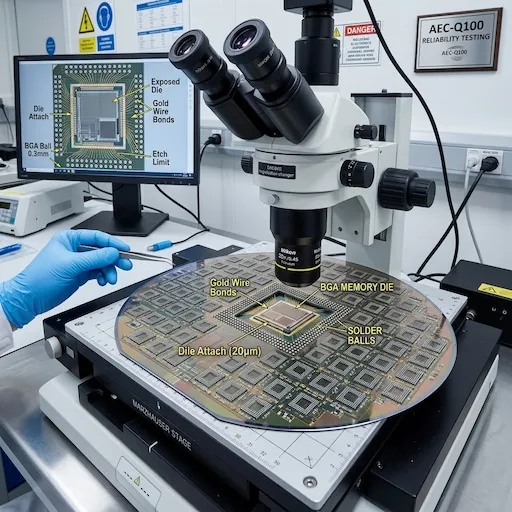
- Decapsulation Testing (Decap): Chemical acid etching is used to inspect the underlying silicon die, verifying proprietary logos (Samsung, Kingston) and matching manufacturer copyright stamps.
- Hermetic Moisture Sensitivity Level (MSL) Auditing: Obsolete plastic BGA packages are highly prone to moisture absorption over long storage periods. Audited suppliers must bake and dry-pack all memory components to prevent board-level “popcorning” failures during SMT reflow.
Conclusion
Securing supply chains for legacy mobile memory in industrial IoT requires a blend of rigorous packaging analysis and verified excess inventory tracking. By establishing dual-sourcing parameters between standard Kingston eMCPs and Samsung LPDDR3 components, B2B procurement managers can protect mature products from EOL disruptions and safely extend device lifecycles.
Frequently Asked Questions (FAQ)
Why is sourcing legacy mobile eMCP memory like the 16EMCP08 so difficult in 2026?
Major memory manufacturers (Samsung, Micron, SK Hynix) have transitioned fabrication lines to advanced UFS 4.0 nodes. Mature eMCP packages like the FBGA162 16EMCP08 are EOL, leaving industrial IoT builders to rely on vetted excess B2B inventories.