Table of Contents
The 2026 Obsolescence Landscape
The traditional lifespan of a commercial off-the-shelf (COTS) IC used to be 10 to 15 years. Today, component lifecycles are shrinking dramatically. The mismatch between the 2-year lifecycle of consumer electronics and the 20-year lifecycle of a medical imaging machine creates a structural supply chain fault line.
When a manufacturer issues a Product Discontinuation Notice (PDN), the clock starts ticking. Procurement teams typically have 6 months to place final orders (the LTB window) and another 6 months before final shipments are made. Failing to act within this window leaves OEMs exposed to exorbitant spot market prices or the devastating cost of a forced system redesign.
Core Strategies for Managing Obsolescence
To build a resilient procurement framework in 2026, companies must implement a multi-tiered approach.
1. Automated PCN and PDN Monitoring
Separate changes to continuing products from discontinuation decisions. A semiconductor PCN review workflow maps the notice to exact ordering codes, qualification evidence, and affected shipments before material is accepted. Manual tracking of hundreds of component manufacturers is no longer feasible. Best-in-class procurement organizations utilize automated BOM scrubbing tools that ingest the company’s entire parts list and continuously monitor global PCN databases. Predictive analytics can flag components at “High Risk” of obsolescence based on the manufacturer’s typical lifecycle patterns and current foundry capacity constraints.
2. Strategic Last Time Buys (LTB)
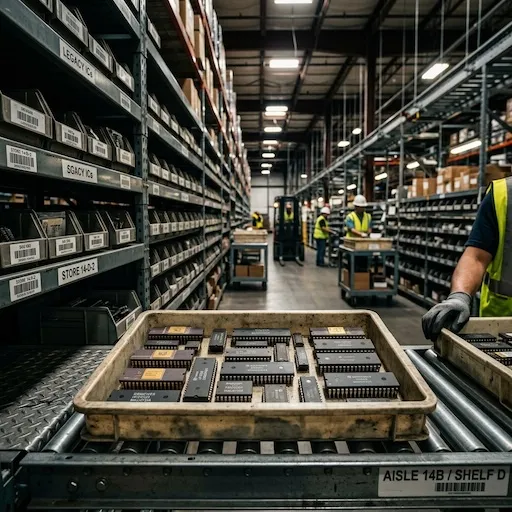
When an LTB is announced for a critical component like a specific Realtek audio codec or a legacy SRAM chip, calculating the exact quantity required is a complex financial and operational decision.
- The Calculation: Multiply the expected remaining product lifecycle by the forecasted annual run rate, adding a buffer for warranty repairs, field replacements, and scrap rates.
- The Financial Hurdle: LTBs require massive upfront capital and tie up cash flow in inventory that may sit on shelves for a decade. Some strategic distribution partners now offer inventory financing and warehousing, allowing OEMs to secure the LTB stock while taking delivery (and paying) on a scheduled release basis.
3. Qualifying Form-Fit-Function (FFF) Alternatives
If the LTB window is missed, the immediate next step is cross-referencing. Finding a Pin-to-Pin (P2P) compatible replacement is ideal but rare for complex ASICs or proprietary MCUs. More often, engineering teams must qualify a Form-Fit-Function alternative. This requires collaboration between procurement and engineering to validate that the new component meets all thermal, electrical, and timing specifications without requiring a costly PCB re-spin.
The Role of Independent Distribution in Obsolescence
Despite the best planning, “line down” situations due to obsolescence occur. When franchised stock is depleted, the open market—navigated via independent distributors—is the final safety net.
However, sourcing EOL parts from the open market carries the highest risk of encountering counterfeit or reclaimed components.
| Risk Factor in Open Market EOL Sourcing | Required Independent Distributor Capability |
|---|---|
| Counterfeit / Remarked Parts | In-house or partnered ISO 17025 laboratory for Chemical Decapsulation and high-power microscopy. |
| Reclaimed / Used Parts | X-Ray Fluorescence (XRF) to check lead finishes and Real-Time X-Ray to inspect internal wire bonds. |
| Solderability Degradation (Age) | J-STD-002 Solderability testing and proper baking/dry-packing procedures for moisture-sensitive devices. |
Your independent distributor must be a technical partner, not a broker. Demand comprehensive inspection reports and traceability documentation for every EOL component procured.
Frequently Asked Questions (FAQ)
What is a Last Time Buy (LTB) in electronic procurement?
How can we manage the cash flow impact of a massive Last Time Buy?
Is it safe to buy obsolete components from independent distributors?
Frequently Asked Questions (FAQ)
What are the main sourcing challenges for this semiconductor family in 2026?
Proactive obsolescence management is a strategic necessity in 2026. OEMs must monitor component lifecycles, purchase lifetime buys for critical ICs, a...