Table of Contents
- What Is the Ground-Level Status of CHIPS Act Funding for Foundries like Intel and Micron in 2026?
- Why Do Regulatory Hurdles and Cleanroom Commissions Keep New Fab Lead Times Fixed at 3 to 5 Years?
- How Should OEMs Adjust Sourcing Allocations During the Transatlantic Semiconductor Reshoring Period?
- 1. Formulate Long-Term Dual-Sourcing Programs
- 2. Leverage Vetted Independent Distribution
- 3. Establish Rolling Forecasts and Safety Buffers
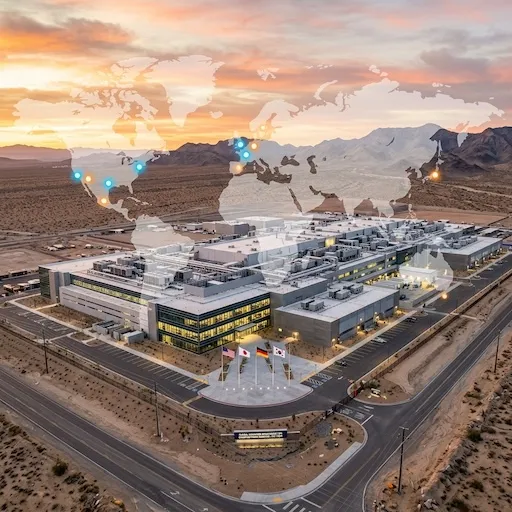
In the global supply chain environment of mid-2026, geographic diversification has transitioned from a boardroom discussion to a critical operational requirement. Following years of geopolitical tensions and export control updates, governments in the United States and Europe are actively funding regional semiconductor manufacturing.
Through the US CHIPS and Science Act and its European equivalent, hundreds of billions of dollars are flowing into local foundry programs. For purchasing directors, the key concern is translating these large-scale investments into actual wafer allocations.
Understanding the ground-level progress of these new fabs and their realistic timelines is critical to formulating your long-term BOM resilience strategy.
What Is the Ground-Level Status of CHIPS Act Funding for Foundries like Intel and Micron in 2026?
The global foundry landscape is undergoing a massive shift. Fabs are transitioning from cleanroom construction into the highly complex process of tooling installation and yield calibration.
While public announcements suggest rapid progress, the physical timeline from groundbreaking to high-volume commercial production remains fixed at 36 to 60 months. The table below details the mid-2026 status of the key reshoring programs:
| Foundry Program | Geographic Location | Mid-2026 Operational Status | Planned Output Nodes |
|---|---|---|---|
| TSMC Arizona (Fab 1) | Phoenix, Arizona, USA | Tooling installation and trial runs; commercial output expected Q1 2027. | 4nm / 5nm FinFET for high-end logic. |
| Intel Foundry (Fab 52/53) | Ocotillo, Arizona, USA | Initial cleanroom qualification and pilot silicon runs completed. | Intel 18A (sub-2nm equivalent). |
| TSMC Kumamoto (JASM Fab 1) | Kikuyo, Kumamoto, Japan | Volume commercial shipping initiated; currently ramping up utilization. | 12nm / 16nm and 22nm/28nm planar nodes. |
| Micron Mega-Fab | Clay, New York, USA | Structural steel frameworks completed; cleanroom build-out ongoing. | High-density DRAM and HBM3E/HBM4. |
| Intel Ohio (Fab 1/2) | New Albany, Ohio, USA | Facilities construction ongoing; pilot operations delayed to late 2027. | Advanced logic nodes for AI clusters. |
As the table shows, mature planar nodes—which power thousands of industrial and automotive subsystems—receive minor funding allocations compared to advanced nodes. Sourcing trailing-edge logic (such as the standard microcontrollers or PMICs from Infineon or NXP) will remain highly volatile because few foundries are building new 65nm fabs.
Why Do Regulatory Hurdles and Cleanroom Commissions Keep New Fab Lead Times Fixed at 3 to 5 Years?
A common procurement mistake is assuming that billions in funding can accelerate fab build-outs overnight. Sourcing managers must understand the physical constraints of fab construction:
- Seismic and Mechanical Stability: Cleanrooms must be completely isolated from surrounding physical vibrations. Foundations require pouring thousands of tons of steel-reinforced concrete directly into bedrock, a process that cannot be rushed.
- Ultra-Pure Water (UPW) and Chemical Outfitting: Fabricating modern integrated circuits requires millions of gallons of ultra-pure water daily. Installing and certifying massive UPW recycling networks and complex chemical handling manifolds takes upwards of 12 months.
- Cleanroom Airborne Audits: Certifying cleanrooms to ISO Class 1 requirements (no more than 10 microscopic particles per cubic meter of air) requires installing massive HEPA filter arrays and running extensive filtration cycles. Any contamination event delays the tooling move-in phase by months.
These physical constraints are why promising fab capacity cannot solve near-term inventory shortages.
How Should OEMs Adjust Sourcing Allocations During the Transatlantic Semiconductor Reshoring Period?
To protect your manufacturing pipeline while global fab capacity normalizes, purchasing departments must adopt immediate strategic measures:
1. Formulate Long-Term Dual-Sourcing Programs
Qualifying compatible alternatives is the most effective way to eliminate single-source supply risks. If a specific component is single-sourced from a fab in an allocation state, engineering must qualify a pin-compatible alternative. While this incurs design costs, it prevents long-term line-down events.
2. Leverage Vetted Independent Distribution
During allocation bottlenecks, independent distributors act as a vital bridge. They can source from excess OEM warehouse stocks and surplus contract manufacturer inventories. When sourcing on the open market, ensure the parts pass rigorous QA verification to prevent degraded or remarked components from entering your assemblies.
3. Establish Rolling Forecasts and Safety Buffers
Transition from Just-in-Time (JIT) buying structures to secure long-term rolling allocations. Establishing inventory safety buffers for high-risk components ensures your assembly line is protected against sudden supply disruptions.
At SupplyICs, we work with global OEMs to manage their excess inventories, securing certified, traceable components during market allocation periods. If your production lines are facing delays, you can upload your BOM directly to our BOM Upload Page or get in touch with a supply chain consultant on our SupplyICs Contact Page.
Frequently Asked Questions (FAQ)
What is the ground-level status of US CHIPS Act fab constructions in mid-2026?
Major projects like TSMC Arizona Fab 1 and Intel's Ohio Fab 1 are in the tooling installation and cleanroom qualification phases, with commercial output delayed to late 2026 or mid-2027.
Why do semiconductor fab construction timelines remain at 3 to 5 years despite billions in funding?
Fab construction requires complex structural engineering, specialized cleanroom outfitting, and extensive yield calibration cycles that cannot be bypassed by capital alone.