Table of Contents
The semiconductor supply chain is undergoing its most dramatic reconfiguration since the end of the Cold War. As of early 2026, the convergence of geopolitical tensions, national security concerns, and the strategic imperative of technological sovereignty has produced an export control regime of unprecedented complexity. For procurement professionals and supply chain managers, understanding this new landscape is no longer optional—it is existential.
U.S. import tariffs require a separate classification, origin, end-use, and entry-date analysis. The 2026 semiconductor tariff and landed-cost guide keeps that import-duty workflow distinct from export licensing.
The New Geography of Chip Manufacturing
The geography of advanced semiconductor manufacturing has shifted decisively. TSMC’s Arizona fabs are now producing 4nm chips at scale, Samsung’s Taylor, Texas facility has reached full operational capacity for 3nm GAA (Gate-All-Around) process technology, and Intel’s Ohio mega-site has begun shipping 18A (1.8nm-class) wafers to foundry customers. The United States, which accounted for approximately 12% of global advanced chip manufacturing capacity in 2020, now commands roughly 22% according to SIA estimates released in Q1 2026.
This reshoring has not come cheaply. The CHIPS Act has disbursed over $52 billion in grants and loan guarantees, catalyzing an estimated $450 billion in private investment across the semiconductor ecosystem. But the real costs of this transition are buried in supply chain complexity.
“The geographic diversification we’re seeing isn’t just about building fabs,” explains Dr. Sarah Chen, a semiconductor supply chain researcher at MIT’s Industrial Performance Center. “It’s about rebuilding entire supplier ecosystems—chemical suppliers, equipment manufacturers, substrate producers, and packaging facilities—that have been concentrated in East Asia for 30 years.”
Export Controls: The Moving Target
The U.S. Department of Commerce’s Bureau of Industry and Security (BIS) has issued seven significant rule updates since October 2022, each expanding the scope of controlled technologies. The most consequential for procurement teams, issued in February 2026, extends controls to a broader range of semiconductor manufacturing equipment (SME) and Electronic Design Automation (EDA) software, while tightening the de minimis rule on foreign-made items containing controlled U.S. technology.
Key developments in 2026 include:
-
Expanded Entity List: Over 180 new entities have been added to the BIS Entity List since January 2025, primarily targeting AI chip developers, advanced packaging facilities, and semiconductor equipment manufacturers in China and, increasingly, in third countries facilitating transshipment.
-
Third-Country Controls: The Foreign Direct Product Rule (FDPR) now applies to items destined for entities in over 40 countries when those items incorporate controlled U.S.-origin technology above specified thresholds. This has created a compliance nightmare for multinational procurement organizations.
-
Technology-Specific Thresholds: Compute performance and transistor density thresholds that trigger licensing requirements have been revised downward three times in 24 months. As of March 2026, chips with a Total Processing Performance (TPP) exceeding 2400 and a performance density above 5.92 are subject to notification requirements even when shipped to allied nations.
Supply Chain Fragmentation and Its Costs
The semiconductor supply chain is fragmenting along geopolitical lines. What was once a relatively efficient global network is being replaced by parallel, partially redundant supply chains serving different geopolitical blocs.
This fragmentation imposes real costs. According to a Boston Consulting Group analysis published in March 2026, the incremental cost of maintaining parallel supply chains for advanced semiconductors adds approximately 25-35% to total landed costs for chips destined for controlled markets. For legacy nodes (28nm and above), the cost premium is lower—approximately 10-15%—but still significant given the thin margins in those segments.
Procurement organizations are responding with several strategies:
-
Multi-Region Sourcing Mandates: Large OEMs and EMS providers are requiring suppliers to maintain qualified manufacturing sources in at least two distinct geopolitical regions for each critical component. This “dual qualification” requirement has become standard in defense, aerospace, and telecommunications supply chains.
-
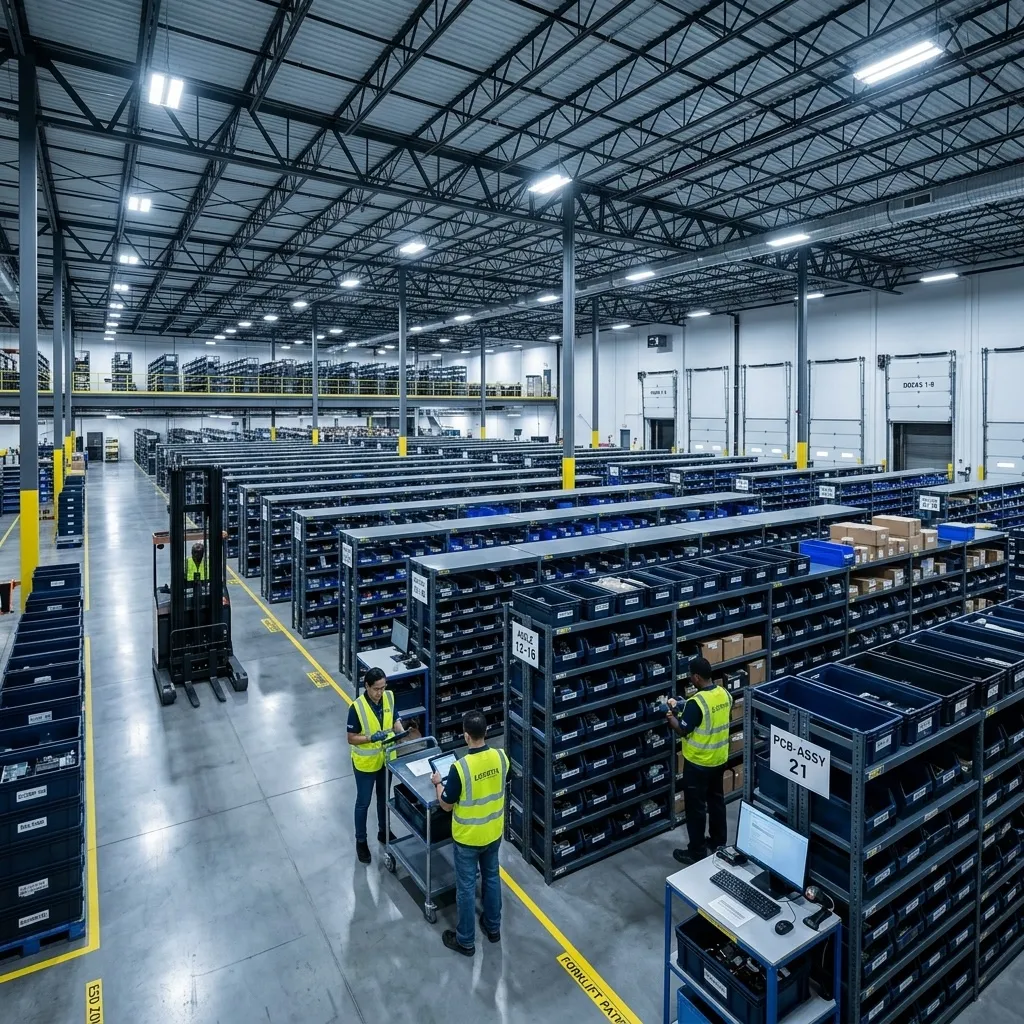
Strategic Inventory Programs: Just-in-time inventory management, already battered by the 2020-2022 shortage cycle, is giving way to “just-in-case” strategies. Companies are maintaining six to twelve months of buffer stock for chips subject to export controls, up from the traditional 30-60 days.
-
Bill of Materials Audits: Organizations are conducting comprehensive audits of their BOMs to identify components that could be subject to future export controls. Components with U.S.-origin technology above 25% by value are flagged for risk assessment.
The Rise of “Friendly Shoring”
A new pattern is emerging that supply chain analysts have dubbed “friendly shoring”—the concentration of critical semiconductor manufacturing within allied nations with aligned export control regimes. Japan, South Korea, Taiwan, the Netherlands, Germany, and the United States are the primary nodes in this emerging network.
Japan’s Rapidus consortium, backed by $35 billion in government support, is now producing 2nm-class chips at its Chitose, Hokkaido facility. The EU Chips Act has catalyzed major investments: TSMC’s Dresden fab (28/22nm, automotive-grade), Intel’s Magdeburg mega-site (18A and below), and STMicroelectronics’ expanded SiC campus in Catania, Sicily are all under construction with significant government co-investment.
India has emerged as a wildcard. With $15 billion in semiconductor incentives announced in 2025 and a rapidly growing domestic electronics market, India is positioning itself as an alternative destination for OSAT (Outsourced Semiconductor Assembly and Test) and, eventually, front-end manufacturing. Micron’s Sanand, Gujarat ATMP facility began operations in late 2025, and Tata Electronics’ Dholera fab (28nm, in partnership with Powerchip Semiconductor) is on track for 2027 production.
Implications for Procurement Professionals
For procurement professionals sourcing electronic components, the 2026 landscape demands new competencies:
-
Regulatory Intelligence: Understanding not just component specifications and pricing, but the export control status, technology classification, and jurisdiction of origin for every part on the BOM. Procurement teams are hiring trade compliance specialists and investing in automated screening tools.
-
Supplier Diversification: Reducing dependence on any single geography or supplier. This means qualifying alternative sources for critical components, even when those alternatives come with a price premium or longer qualification cycles.
-
Lifecycle Planning: For products with long lifecycles (defense, aerospace, industrial equipment), procurement teams must model supply chain risks 5-10 years into the future, accounting for potential shifts in the geopolitical landscape.
-
Relationship Management: In a constrained environment, allocation is everything. Organizations that have invested in deep supplier relationships, transparent forecasting, and long-term commitments are securing supply while transactional buyers face extended lead times.
Looking Ahead
The semiconductor supply chain of 2030 will look very different from the one we knew in 2020. The forces driving this transformation—geopolitical competition, technological nationalism, and the recognition of semiconductors as strategic assets—are structural, not cyclical. They will not reverse with the next election cycle or trade negotiation.
For procurement organizations, the path forward is clear: invest in supply chain resilience, build regulatory expertise, diversify sources, and accept that the era of frictionless global semiconductor trade is over. Those who adapt quickly will find competitive advantage in reliability and certainty of supply. Those who do not will find themselves unable to ship products in an increasingly constrained world.
SupplyICs maintains a dedicated regulatory monitoring team to track export control developments affecting semiconductor procurement. Contact our sourcing specialists for guidance on specific component classifications and alternative sourcing strategies.
Frequently Asked Questions (FAQ)
What are the main sourcing challenges for this semiconductor family in 2026?
Geopolitical export controls continue to reshape advanced logic and memory supply chains in 2026. B2B buyers must implement regionalized dual-sourcing...