Table of Contents
- The Structural Forces Shaping MCU Availability
- STMicroelectronics (STM32 Family)
- Infineon Technologies (XMC, AURIX, PSoC Families)
- NXP Semiconductors (S32, i.MX RT, LPC, Kinetis Families)
- Renesas Electronics (RA, RX, RH850 Families)
- Microchip Technology (PIC, AVR, SAM Families)
- The Procurement Playbook: Five Actions for Mid-2026
The microcontroller market in May 2026 is a study in stratification. Talk to five different procurement managers and you will hear five different experiences: one reports STM32F4-series parts arriving in eight weeks, another is being quoted 40 weeks for the same family in a different package and memory configuration. A third has given up on franchised distribution entirely for certain NXP S32K derivatives and is sourcing exclusively through independent channels.
This is not market dysfunction—it is the natural outcome of a supply chain where allocation decisions are made at the wafer level, propagated through package-specific and configuration-specific inventory buffers, and ultimately experienced by buyers as apparently random availability. Understanding what is actually happening requires looking past the headline lead time numbers and into the structural dynamics that drive allocation at each major MCU supplier.
This article provides a current, brand-by-brand analysis of the MCU supply landscape as of mid-May 2026, drawing on SupplyICs procurement desk data, distributor inventory monitoring, manufacturer earnings commentary, and direct conversations with wafer foundry and OSAT industry contacts.
The Structural Forces Shaping MCU Availability
Before examining individual suppliers, it is worth understanding the three forces that are shaping MCU availability across the entire market in 2026:
1. The 28-40nm Node Bottleneck. The majority of 32-bit MCUs—including STM32F4/G4/H7, NXP S32K, Infineon AURIX TC3xx, and Renesas RH850—are fabricated on 28nm, 40nm, or 55nm process nodes. These are mature nodes with high demand from multiple sectors (automotive, industrial, IoT, communications infrastructure) and limited greenfield capacity additions. Unlike leading-edge nodes (3nm, 5nm), where capacity is being added aggressively by TSMC, Samsung, and Intel, mature node capacity growth has lagged behind demand. The result is structural tightness that will persist even if end-market demand softens.
TSMC’s 28nm capacity utilization has been running at close to 100% for 24 consecutive months, per the foundry’s Q1 2026 earnings call. SMIC’s 28nm expansion adds meaningful capacity, but most Western MCU suppliers remain dependent on TSMC, UMC, and GlobalFoundries for wafer supply. The China-based 28nm capacity largely serves domestic fabless companies and is not easily accessible to ST, NXP, or Infineon.
2. Automotive Demand Is Absorbing Disproportionate Wafer Allocation. A modern vehicle contains 30-50 MCUs, up from 20-25 in 2019. Vehicle production in 2026 is running at approximately 91 million units globally, up 3% year-over-year. Each additional million vehicles, at an average of 40 MCUs per vehicle, requires roughly 40 million incremental MCUs—equivalent to thousands of additional wafer starts per month on mature nodes.
Automotive MCUs command higher ASPs and carry multi-year platform commitments that make them more attractive to foundries than consumer or industrial MCU business, which can be more price-sensitive and volatile. The foundry’s economic incentive is clear: allocate wafer capacity to the highest-margin, longest-commitment customer. The result is that automotive-grade MCU supply is prioritized, and commercial/industrial-grade availability at the same supplier is the residual.
3. Package-Specific and Configuration-Specific Constraints. An MCU is not a commodity: the same STM32F407 die in an LQFP-64 package, an LQFP-100 package, and a BGA-100 package represents three distinct supply chains through assembly and test. A shortage in LQFP-100 leadframes or molding compound does not affect LQFP-64 availability of the same die, but a buyer searching for “STM32F407” sees only “out of stock” and assumes the entire family is unavailable.
Similarly, memory configuration variants within the same MCU family—256KB Flash vs. 1MB Flash, 64KB SRAM vs. 256KB SRAM—are separate part numbers that consume the same wafer allocation but have different demand profiles. The 1MB Flash variant may be allocated while the 256KB variant is not, simply because the 1MB variant is in higher demand for a specific automotive platform.
STMicroelectronics (STM32 Family)
Current Lead Times (May 2026):
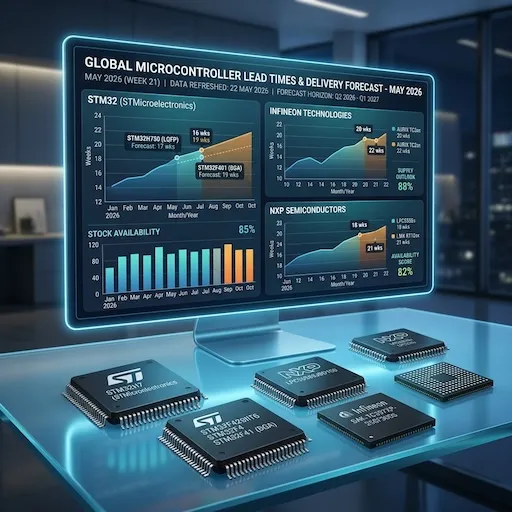
| STM32 Series | Core / Node | Lead Time | Trend | Notes |
|---|---|---|---|---|
| STM32F0 / F1 | Cortex-M0/M3, 90-180nm | 8-12 weeks | → Stable | Catalog availability improving; LQFP-48/64 best supplied |
| STM32F2 / F4 | Cortex-M3/M4, 90nm | 14-22 weeks | → Stable to ↑ | STM32F407/417 in LQFP-100 tight; BGA variants tighter |
| STM32F7 / H7 | Cortex-M7, 40nm | 26-40 weeks | ↑ Tightening | H743/H753 under allocation; H7R/S (new) in sampling only |
| STM32G0 / G4 | Cortex-M0+/M4, 90nm | 10-16 weeks | → Stable | G4 series demand growing rapidly (digital power) |
| STM32L4 / L5 | Cortex-M4/M33, 90-40nm | 14-24 weeks | → Stable | L4+ (L4R5/L4S5) still constrained on specific packages |
| STM32MP1 (MPU) | Cortex-A7+M4, 65nm | 16-24 weeks | → Stable | Not allocation-restricted; long lead times due to assembly complexity |
| SPC5 (Automotive) | e200z, 55-40nm | 26-40 weeks | ↑ Tightening | Tight allocation; 26-week minimum for new orders |
Procurement Intelligence. ST’s Q1 2026 earnings call reported MCU revenue of $2.48 billion, up 6% year-over-year. The company’s Crolles 300mm fab (France) and Agrate 300mm fab (Italy) are the primary wafer sources for STM32 MCUs, with assembly concentrated in ST’s Bouskoura (Morocco) and Muar (Malaysia) facilities, plus OSAT partners in Taiwan and China.
The key development for STM32 procurement in 2026 is the ramp of ST’s 18nm FD-SOI process for next-generation MCUs (STM32N series, expected sampling in late 2026). This will not help current availability—the 18nm parts will initially be constrained—but signals ST’s strategy to migrate MCU production off the congested 28-40nm nodes onto a process where they have differentiated capacity and less competition for wafers.
For procurement teams, the practical implication is that mainstream STM32F1/F0 availability is the best it has been since 2021, while high-performance STM32H7 and automotive SPC5 availability is effectively unchanged from the 2022-2023 shortage period. The bifurcation is structural, not cyclical.
P2P Cross-Reference Options. For STM32F1-series parts, GigaDevice GD32F1 and GD32F3 series offer the closest P2P alternatives, using the same ARM Cortex-M3/M4 cores and substantially compatible pinouts. For STM32F4, GigaDevice GD32F4 provides functional compatibility with firmware porting effort estimated at 2-4 engineering weeks for typical applications. For STM32H7, there is no direct P2P alternative; the closest functional alternative is the NXP i.MX RT1060/1170 series, which offers comparable Cortex-M7 performance but with different peripherals and toolchain requirements.
For control-oriented STM32G4 demand, use the STM32G474RET6 motor-control and digital-power sourcing guide to separate the exact LQFP64 order code, integrated analog resources, silicon revision and live quote evidence from this family-wide outlook.
Infineon Technologies (XMC, AURIX, PSoC Families)
Current Lead Times (May 2026):
| Infineon MCU Series | Core / Node | Lead Time | Trend | Notes |
|---|---|---|---|---|
| XMC1000 / XMC4000 | Cortex-M0/M4, 65-40nm | 14-20 weeks | → Stable | Industrial-focused; XMC4000 in VQFN-48 tighter than LQFP |
| AURIX TC2xx | TriCore, 65nm | 20-30 weeks | → Stable | Mature product; second-source qualification window open |
| AURIX TC3xx | TriCore, 40nm | 26-40 weeks | ↑ Tightening | TC387/TC389/TC397 under the tightest allocation |
| AURIX TC4xx | TriCore Gen 6, 28nm | 40+ weeks | ↑ Allocation Only | New product ramp; allocation to strategic automotive Tier 1s |
| PSoC 4 / PSoC 6 | Cortex-M0/M4, 90-40nm | 12-18 weeks | → Stable | PSoC 4100S/4200 in QFN-48 most available |
| TRAVEO T2G | Cortex-M4/M7, 40nm | 18-26 weeks | → Stable | Post-acquisition (Cypress) integration complete; supply stable |
Procurement Intelligence. Infineon’s MCU portfolio expanded substantially with the Cypress acquisition, giving it the AURIX (automotive power-train/safety), TRAVEO (automotive body/zone), XMC (industrial), and PSoC (IoT/consumer) families. The AURIX TC3xx series is the company’s most constrained product line, driven by strong demand for EV traction inverter and ADAS domain controller applications.
Infineon added approximately 15% to its mature-node wafer procurement in 2025, but the incremental capacity has been absorbed by AURIX TC4xx ramp (28nm wafers at TSMC) rather than increasing TC3xx availability. The TC3xx uses 40nm process technology, and capacity additions at that node are limited.
A practical procurement consideration for Infineon MCU buyers: the TRAVEO T2G family, which competes with NXP S32K and Renesas RH850 in automotive body/zone controller applications, currently has better availability than AURIX TC3xx. For non-safety-critical body electronics applications, a TRAVEO T2G may be a viable alternative to an AURIX TC3xx, with shorter lead times and a growing P2P cross-reference library.
P2P Cross-Reference Options. The most notable cross-reference opportunity is between Infineon AURIX TC3xx and STMicroelectronics SPC58 series for automotive safety applications. Both are 32-bit automotive MCUs fabricated on 40nm at TSMC, both support ASIL-D, and both offer LQFP-176/BGA-292 package options. However, the TriCore vs. Power Architecture ISA difference means firmware porting is required. For XMC4000 industrial MCUs, ST STM32F4 serves as a functional alternative with Cortex-M4 core, though peripheral mapping differs.
NXP Semiconductors (S32, i.MX RT, LPC, Kinetis Families)
Current Lead Times (May 2026):
| NXP MCU Series | Core / Node | Lead Time | Trend | Notes |
|---|---|---|---|---|
| S32K1 (Auto Body) | Cortex-M4, 55nm | 18-28 weeks | ↑ Tightening | S32K144/S32K146 tight; QFP-100 under most pressure |
| S32K3 (Auto Body/Zone) | Cortex-M7, 28nm | 26-40 weeks | ↑ Tightening | New platform; allocation constrained for non-automotive users |
| S32G (Vehicle Network) | Cortex-A53+M7, 16nm | 30-40 weeks | ↑ Allocation Only | Advanced 16nm FinFET; limited foundry capacity allocation |
| i.MX RT10xx (Crossover) | Cortex-M7, 28-40nm | 16-26 weeks | → Stable to ↑ | RT1060/RT1064 in BGA tighter than RT1050/RT1020 in LQFP |
| i.MX RT117x (Crossover) | Cortex-M7+M4, 28nm | 20-30 weeks | ↑ Tightening | New dual-core architecture; strong demand from industrial HMI |
| LPC5500 / LPC54000 | Cortex-M33/M4, 40nm | 10-16 weeks | → Stable | LPC55S69 (secure) well-supplied; LPC546xx improving |
| Kinetis K6x / K7x (Legacy) | Cortex-M4, 90nm | 12-20 weeks | → Stable | Mature product; NXP encouraging migration to i.MX RT or S32 |
Procurement Intelligence. NXP’s MCU strategy is organized around the S32 platform for automotive and the i.MX RT series for industrial crossover applications. The legacy Kinetis and LPC families continue to be supported but are not receiving significant new wafer allocation—NXP is actively managing the transition of customers to the newer platforms.
The S32K3 is NXP’s most constrained MCU line. Fabricated on TSMC’s 28nm process, S32K3 competes for wafer allocation with NXP’s own i.MX RT11xx series, other TSMC customers’ 28nm designs, and the general tightness of the 28nm node. NXP’s Q1 2026 earnings call noted that S32K3 backlog extends into mid-2027, though the company expects a “meaningful” capacity increase in Q3 2026 as additional 28nm wafers become available from TSMC’s Nanjing and Arizona fabs.
For procurement teams currently designing with or sourcing S32K1 products, NXP has publicly stated that S32K1 will be supported through at least 2035, but wafer allocation will not increase. This is effectively a signal that S32K1 availability will tighten over time as wafer starts are redirected to S32K3. A second-source strategy for S32K1-based designs should be a priority.
P2P Cross-Reference Options. The S32K1 family’s most discussed second source is the ST SPC5 series (automotive Power Architecture), though as noted above this requires firmware porting. For the i.MX RT10xx series, NXP itself offers the most viable path through the i.MX RT118x (updated 28nm version of the RT1050/1060 architecture), which may have better availability due to process migration. External alternatives include the Renesas RZ/T2M for real-time industrial Ethernet applications.
Renesas Electronics (RA, RX, RH850 Families)
Current Lead Times (May 2026):
| Renesas MCU Series | Core / Node | Lead Time | Trend | Notes |
|---|---|---|---|---|
| RA2 / RA4 / RA6 | Cortex-M4/M33/M4, 40nm | 8-14 weeks | ↓ Improving | RA6M4/RA6M5 in LQFP-100/144 well-supplied |
| RA8 (New) | Cortex-M85, 40nm | 16-24 weeks | → Stable | New product ramp; early adopter allocation available |
| RX series (RX65N/RX72N) | RXv3, 40nm | 12-20 weeks | → Stable | Industrial HMI strong; RX72N QFP-176 improving |
| RH850 (Auto) | RH850, 40nm | 20-32 weeks | → Stable to ↑ | RH850/P1x (chassis/safety) tighter than RH850/F1x (body) |
| RZ/T (Real-Time MPU) | Cortex-R52, 28nm | 16-24 weeks | → Stable | Dedicated industrial Ethernet MPU; supply improving |
| R-Car (Auto SoC) | Cortex-A76+A55+R52, 7nm | 26-40 weeks | ↑ Tightening | Advanced SoC; same 7nm capacity constraints as all leading-edge |
Procurement Intelligence. Renesas has been the standout performer in MCU supply recovery through the first half of 2026. The RA family, which is Renesas’s mainstream ARM Cortex-M MCU platform, shows the best availability of any 32-bit ARM MCU family among the top five suppliers, with lead times for common RA4 and RA6 variants in LQFP packages running 8-14 weeks.
This is partly the result of Renesas’s strategy of maintaining its own 300mm fab capacity (Naka, Japan) for MCU production, rather than relying exclusively on foundry partners. While ST, NXP, and Infineon all depend on TSMC for a significant share of MCU wafer fabrication, Renesas fabricates approximately 60% of its MCU wafers internally, giving it greater control over allocation and prioritization.
The RH850 automotive series remains the exception to Renesas’s improving supply picture. Strong demand from Japanese automotive Tier 1s, combined with the complexity of automotive qualification requirements, keeps RH850 lead times elevated at 20-32 weeks. The new R-Car Gen 5 automotive SoCs on 7nm face the same leading-edge capacity constraints as all advanced-node products.
P2P Cross-Reference Options. Renesas RA6 series MCUs offer a credible cross-reference path for STM32F4 designs, with compatible Cortex-M4 cores, overlapping peripheral sets, and comparable package options. The migration effort for RA6 from STM32F4 is estimated at 3-5 engineering weeks for typical industrial applications—less than the STM32F4-to-i.MX RT transition, owing to the shared ARM ecosystem and compatible toolchain (IAR, Keil, GCC).
Microchip Technology (PIC, AVR, SAM Families)
Current Lead Times (May 2026):
| Microchip MCU Series | Core / Node | Lead Time | Trend | Notes |
|---|---|---|---|---|
| PIC16 / PIC18 (8-bit) | PIC, 250nm+ | 4-8 weeks | ↓ Improving | Catalog availability essentially normal |
| PIC32MK / PIC32MZ | MIPS M4K, 55nm | 8-16 weeks | → Stable | Best availability among 32-bit PIC families |
| AVR (8-bit) | AVR, 180nm+ | 4-8 weeks | ↓ Improving | ATmega328P/ATmega2560 well-supplied |
| ATSAM (ARM) | Cortex-M4/M7, 55nm | 12-20 weeks | → Stable | SAM E70/S70 (automotive) tighter than SAM D5x/E5x (general) |
| SAM9X60 (MPU) | ARM926EJ-S, 65nm | 8-14 weeks | → Stable | Legacy ARM9 MPU; well-supplied, no allocation |
Procurement Summary. Microchip is in the best supply position among major MCU suppliers as of May 2026. The company’s strategy of maintaining very mature internal fab capacity (Tempe, AZ; Gresham, OR; Colorado Springs, CO) for MCU production insulates it from the 28-40nm node congestion affecting competitors. The trade-off is performance: PIC32 and SAM parts are competitive for many industrial and consumer applications but do not match the performance-per-watt of STM32H7, i.MX RT, or RA8 devices built on 40-28nm processes. For applications where a 55nm Cortex-M4 at 200 MHz is sufficient, Microchip offers the most reliable supply.
The Procurement Playbook: Five Actions for Mid-2026
1. Segment Your MCU BOM by Criticality, Not Just Spend. A $4 MCU with 40-week lead times and no second source is more dangerous than a $25 MCU with 12-week lead times and two qualified alternatives. Classify every MCU BOM line by: (a) lead time trend (improving, stable, tightening), (b) second-source availability (P2P exists, functional alternative exists, sole source), and (c) line-down impact if unavailable.
2. Differentiate Between Wafer Fab Constraint and Package/Test Constraint. If a specific MCU variant is unavailable, ask whether the constraint is the die or the package. An STM32F429 in LQFP-144 may be unavailable while the same die in BGA-176 is available. The BGA variant may require a PCB change, but if the alternative is 26 weeks of downtime, the board respin may be the rational choice.
3. Engage Independent Distribution as a Strategic Buffer, Not a Spot Market of Last Resort. The independent channel carries inventory of allocated MCUs that the franchised channel cannot supply. Building a relationship with a technically competent independent distributor before the crisis means having access to verified, traceable inventory when allocation hits. SupplyICs maintains relationships with over 200 vetted suppliers globally and performs full incoming inspection on every shipment—including X-ray, decapsulation, and electrical testing where required—to ensure that independently sourced components meet the same quality standard as franchised channel product.
4. Launch Second-Source Qualifications Now for Components Showing Tightening Trends. As detailed in our framework on dual sourcing, the median qualification timeline for a Tier 2 automotive MCU second source is 14-18 months. Starting today means production readiness by late 2027. Starting when the shortage hits means at least a year of exposure.
5. Monitor Silicon Revision Compatibility. The single most overlooked risk in MCU second-sourcing is silicon revision divergence. Two MCUs that were functionally equivalent at a specific revision may diverge when a silicon errata fix changes a register behavior that the application firmware depends on. An ongoing silicon revision monitoring program—tracking PCNs from both the primary and second-source suppliers—is the only reliable defense against silent divergence.
Frequently Asked Questions (FAQ)
What are the main sourcing challenges for this semiconductor family in 2026?
Microcontroller lead times for STM32, Infineon AURIX, and NXP S32 lines remain tight in May 2026. Sourcing requires strict date-code verification and ...