Table of Contents
- Americas: Why Are US Lead Times 30-40 Weeks?
- The Wafer Fabrication Bottleneck
- Regional Supplier Landscape: North America
- The Realtek Opportunity
- Brazil: The Most Complex Market in the Americas
- EMEA: A Tale of Two Supply Chains
- Western and Central Europe
- GCC: The Fastest-Growing Sub-Region
- APAC: Shortest Lead Times, Most Supplier Options
- China’s Market and the Domestic Supplier Push
- India: The Emerging Demand Center
- Regional Lead Time Comparison: Q2 2026
- Sourcing Strategy by Region: A 3-Point Action Plan
- 1. North American Buyers: Qualify Realtek as Second Source
- 2. European Industrial Buyers: Consolidate Around TI DP838xx
- 3. GCC and Latin American Buyers: Pre-Stock Through Regional Distributor Consignment
When a procurement manager in São Paulo orders the same Broadcom BCM84888 10GbE PHY that a buyer in Shenzhen sources routinely, she pays roughly 18-25% more, waits 6-8 weeks longer, and navigates a customs process that adds another 2-3 weeks of uncertainty. The chip is identical. The supply chain is not.
Related Reading: For the AI data center demand drivers reshaping Ethernet PHY markets, see Ethernet PHY Chip Market: AI Impact on Data Center Demand. For automotive Ethernet PHY selection, see Automotive Ethernet PHY Selection Guide: Zonal Networking Components 2026. This article focuses on regional supply chain differences and procurement strategy by geography.
📌 Direct Answer: The Ethernet PHY market splits into three procurement zones: Americas (US $2.93B, Canada, Mexico, Brazil—longest lead times, highest distribution markups, dependent on Asia-based wafer fabrication); EMEA (Germany, UK, France, Italy, Spain, GCC—mixed lead times, growing local distribution, GCC the fastest-growing sub-region at 12% CAGR but entirely import-dependent); and APAC (China, Japan, India, Taiwan, Korea—shortest lead times and lowest pricing due to proximity to TSMC/UMC/GlobalFoundries fab capacity and ASE/SPIL OSAT packaging). Brazil is the outlier: 85% Ethernet PHY import dependency, complex tax structure (ICMS, IPI, PIS/COFINS), and mandatory local certification (Anatel). For US buyers, qualifying Realtek as a cost-competitive second source to Broadcom and Marvell for enterprise PHY requirements is the single highest-ROI sourcing action in 2026.
Americas: Why Are US Lead Times 30-40 Weeks?
The U.S. Ethernet PHY market—valued at $2.93 billion according to Maximize Market Research—is the world’s largest single-country market for Ethernet physical layer components. It is also one of the most constrained.
The Wafer Fabrication Bottleneck
Most commercial Ethernet PHY chips are fabricated on 28nm, 40nm, or 55nm CMOS processes at TSMC (Hsinchu, Taiwan), UMC (Tainan, Taiwan), or GlobalFoundries (Singapore, Dresden). These mature nodes are shared with automotive MCUs, analog ICs, and power management chips—all of which have competing demand. In 2026, TSMC’s 28nm capacity utilization is running above 95%, and new 28nm capacity additions (SMIC Beijing, UMC Tainan P6, GF Singapore expansion) are being absorbed as quickly as they come online.
For multi-port 10GbE PHYs and automotive-grade 1000BASE-T1 devices, the constraint is particularly acute because these products require process qualifications (AEC-Q100 for automotive, extended temperature testing for industrial) that tie them to specific fab lines. You cannot simply move a qualified automotive PHY from TSMC Fab 14 to a different 28nm line without re-qualification—a process that takes 6-12 months for automotive-grade components.
Regional Supplier Landscape: North America
| Supplier | Key PHY Products | US Market Position | Lead Time (Q2 2026) | Notes |
|---|---|---|---|---|
| Broadcom | BCM84888 (10GbE), BCM5461 (GbE) | #1 in data center PHY | 26-40 wks | Priority allocation to hyperscaler customers |
| Marvell | Alaska 88E15xx (GbE), 88X33xx (10GbE) | #1 in enterprise PHY | 20-30 wks | Better availability than Broadcom for non-hyperscaler |
| Texas Instruments | DP838xx (industrial), DP83TC (automotive) | #1 in industrial PHY | 16-24 wks | Strong distribution inventory through TI store |
| Microchip | LAN88xx (automotive), KSZ9xxx (enterprise) | Strong in automotive/aerospace | 18-26 wks | Good availability for industrial-temp variants |
| Realtek | RTL8211 (GbE), RTL8125 (2.5GbE) | Cost leader, growing enterprise | 12-18 wks | Shortest lead times; aggressive pricing |
| Intel | I225/I226 (2.5GbE client) | Client PC and embedded | 14-20 wks | Client-focused; limited enterprise product line |
The Realtek Opportunity
Realtek has quietly become the most pragmatic sourcing option for enterprise GbE and 2.5GbE PHY requirements in 2026. The Taiwanese fabless company designs its PHYs for TSMC and UMC mature nodes and maintains consistent wafer allocation through long-term capacity agreements. Realtek’s RTL8211E GbE PHY and RTL8125 2.5GbE controller are pin-compatible with Broadcom and Marvell equivalents in many designs, and Realtek’s pricing is typically 25-40% below equivalent Broadcom/Marvell parts.
The trade-off is ecosystem maturity: Broadcom and Marvell provide more comprehensive driver support, reference designs, and FAE coverage. But for price-sensitive enterprise and industrial applications where the PHY is a commodity interface, Realtek is increasingly difficult to ignore.
For our detailed Realtek automotive gateway PHY sourcing guide, see: Realtek RTL8198D Automotive Gateway PHY Selection Guide 2026.
Brazil: The Most Complex Market in the Americas
Brazil consumes an estimated $180-220 million in Ethernet PHY chips annually, roughly 6-7% of the Americas market. It is also the most challenging procurement environment in the region:
- 85% import dependency. Almost no Ethernet PHY chips are manufactured or packaged in Brazil. Everything comes through distribution from Asia or the United States.
- Complex tax layering. Imported semiconductors face ICMS (state VAT, 12-18% depending on state), IPI (federal excise tax on industrialized products), PIS/COFINS (social contribution taxes, ~9.25% combined), and additional customs processing fees. The effective tax burden on an imported Ethernet PHY chip can exceed 40% of CIF value.
- Anatel certification. Telecommunications equipment sold in Brazil requires Anatel homologation, adding 8-16 weeks to the qualification timeline for new PHY products.
For procurement teams supplying Brazilian customers, the most practical path is partnering with distributors that maintain local Brazilian inventory (pre-cleared through customs, taxes already paid) and hold valid Anatel certifications for the PHY products in their catalog. Arrow Electronics and Avnet both maintain semiconductor inventory in Brazil; pricing from these distributors includes the tax and logistics burden but eliminates the timeline uncertainty of direct import.
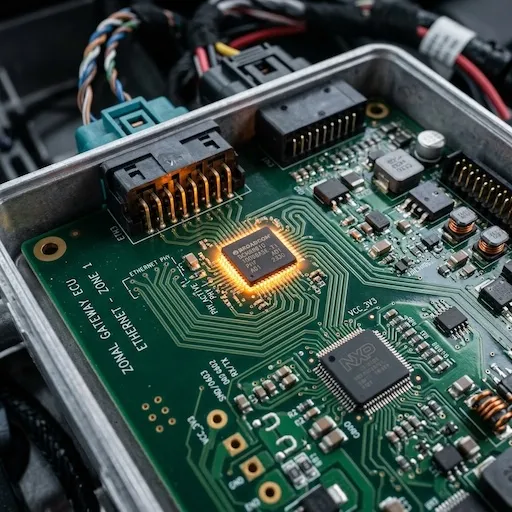 Fig 1: Regional Ethernet PHY supply chain flows. Taiwan-based wafer fabrication feeds OSATs in Taiwan and Malaysia, with distribution hubs in Singapore, Hong Kong, and the Netherlands serving regional markets.
EMEA: A Tale of Two Supply Chains
The EMEA Ethernet PHY market splits into two distinct procurement environments: Western/Central Europe and the GCC (Gulf Cooperation Council).
Western and Central Europe
Germany, the UK, France, Italy, and Spain collectively represent Europe’s largest Ethernet PHY markets, driven by automotive (Germany), industrial automation (Germany, Italy), telecommunications infrastructure (UK, France, Spain), and enterprise networking.
European procurement benefits from strong regional distribution: Arrow, Avnet, Future Electronics, and Rutronik all maintain European semiconductor inventory hubs (primarily in the Netherlands, Germany, and Belgium). For standard GbE PHY products from Broadcom, Marvell, and TI, European lead times run 16-24 weeks—shorter than North America because European distributors have historically maintained higher inventory-to-demand ratios.
The European automotive Ethernet PHY market is also the most competitive globally, with NXP (Netherlands), STMicroelectronics (France/Italy), and Infineon (Germany) all competing alongside the U.S. and Taiwanese suppliers. For automotive 1000BASE-T1 and multi-gigabit automotive Ethernet PHYs, European buyers have more supplier options than buyers in any other region.
The industrial Ethernet segment in Europe is distinguished by strong demand for TSN (Time-Sensitive Networking)-enabled PHYs supporting PROFINET, EtherCAT, and EtherNet/IP real-time protocols. TI’s DP8382x family and Broadcom’s BCM5316x TSN switches are the reference designs for most European industrial automation OEMs.
GCC: The Fastest-Growing Sub-Region
The GCC Ethernet PHY market—driven by Saudi Arabia’s NEOM and Vision 2030 smart city projects, UAE’s AI data center buildout (G42, Microsoft Azure UAE region), and Qatar’s LNG infrastructure modernization—is growing at approximately 12% CAGR, the fastest rate globally according to SNS Insider.
However, the GCC market is entirely import-dependent. There is no semiconductor wafer fabrication, packaging, or testing infrastructure in the Gulf region. Every Ethernet PHY chip sold in the GCC flows through distribution hubs in Singapore or Hong Kong, transiting through Jebel Ali (UAE) or Dammam (Saudi Arabia) ports.
For procurement teams supplying GCC-based projects, the practical implications are:
- Build in 4-6 weeks of logistics buffer on top of Asian factory lead times. Air freight from Singapore to Dubai is 3-5 days; sea freight is 18-24 days. Customs clearance at Jebel Ali typically takes 2-5 business days for electronics imports.
- Qualify Broadcom and Marvell products through their authorized GCC distributors. Both maintain local inventory in Dubai Silicon Oasis and Jebel Ali Free Zone, which can reduce lead times on standard products to 2-4 weeks.
- Be aware of encryption export controls. Some Ethernet PHY products with integrated MACsec security (IEEE 802.1AE) may require export licenses for certain GCC end-users, particularly those with defense or government ties.
APAC: Shortest Lead Times, Most Supplier Options
The APAC region accounts for roughly 55% of global Ethernet PHY consumption and benefits from geographic proximity to the entire semiconductor supply chain: wafer fabs (TSMC, UMC in Taiwan; SMIC, Hua Hong in China), OSATs (ASE, SPIL in Taiwan; JCET in China; UTAC in Singapore), and the franchised distribution ecosystem centered in Singapore, Hong Kong, and Shenzhen.
China’s Market and the Domestic Supplier Push
China’s Ethernet PHY market—estimated at $2.5-3.0 billion—is the world’s second-largest single-country market after the United States. Historically dominated by Broadcom, Marvell, Realtek, and TI, China’s Ethernet PHY supply base is diversifying as domestic suppliers gain capability:
- Motorcomm (Suzhou): The most credible Chinese Ethernet PHY startup, with qualified GbE and 2.5GbE PHYs shipping to Huawei, ZTE, and H3C for enterprise switch and router applications. Motorcomm’s YT8521 GbE PHY has gained significant share in the Chinese enterprise market.
- Centec Communications (Suzhou): Primarily an Ethernet switch chip vendor, Centec also offers integrated switch+PHY solutions for the Chinese telecom and data center markets.
For Western buyers, Chinese Ethernet PHY suppliers are not yet a practical alternative due to limited international distribution, lack of AEC-Q100 qualification for automotive applications, and export control sensitivity. However, for buyers serving the Chinese domestic market or EMS partners manufacturing in China for Chinese end-customers, Motorcomm represents a viable and increasingly price-competitive second source to Realtek for commodity GbE PHY applications.
India: The Emerging Demand Center
India’s Ethernet PHY market is growing at approximately 10% CAGR, driven by telecom infrastructure buildout (Reliance Jio 5G, Bharti Airtel fiber expansion), data center construction (AWS Hyderabad, Google Mumbai), and the “Made in India” electronics manufacturing push.
India, like the GCC, currently has no domestic Ethernet PHY manufacturing. But the government’s $15 billion semiconductor incentive program is beginning to change that: Tata Electronics’ Dholera 28nm fab (in partnership with PSMC) could potentially manufacture Ethernet PHY products from 2028 onward. In the near term, Indian buyers rely on the same distribution channels as the GCC—primarily through Singapore and Hong Kong hubs—with 2-3 weeks of logistics transit time and growing local inventory from Arrow and Avnet’s Indian warehouses.
Regional Lead Time Comparison: Q2 2026
| Region | GbE Single-Port PHY | 10GbE Multi-Port PHY | Automotive 1000BASE-T1 | Industrial-Temp PHY | Price Premium vs. APAC |
|---|---|---|---|---|---|
| APAC (China/Taiwan) | 8-14 wks | 14-20 wks | 16-22 wks | 10-16 wks | Baseline |
| APAC (India) | 12-18 wks | 18-24 wks | 20-26 wks | 14-20 wks | +8-12% |
| North America (US) | 16-24 wks | 30-40 wks | 26-36 wks | 18-26 wks | +15-25% |
| North America (Mexico) | 14-20 wks | 24-32 wks | 22-30 wks | 16-22 wks | +10-18% |
| EMEA (Germany/UK) | 12-18 wks | 18-26 wks | 18-24 wks | 14-20 wks | +10-15% |
| EMEA (GCC) | 16-24 wks | 24-32 wks | 26-34 wks | 18-26 wks | +15-20% |
| Latin America (Brazil) | 20-28 wks | 28-38 wks | 28-36 wks | 20-28 wks | +25-35%* |
Brazil premium includes estimated tax burden (ICMS, IPI, PIS/COFINS) and logistics cost. Source: SupplyICs proprietary lead time tracking, distributor inventory analysis, Q2 2026.
Sourcing Strategy by Region: A 3-Point Action Plan
1. North American Buyers: Qualify Realtek as Second Source
If your BOM currently specifies Broadcom or Marvell Ethernet PHYs as single-source, the most impactful sourcing action you can take in 2026 is qualifying Realtek equivalents. The qualification process for a commodity GbE PHY (where the PHY implements standard IEEE 802.3ab with no vendor-specific features) is typically 4-8 weeks of electrical validation plus software driver integration. The payoff is access to components with 12-18 week lead times (versus 20-40 weeks for Broadcom) at 25-40% lower pricing.
2. European Industrial Buyers: Consolidate Around TI DP838xx
Texas Instruments’ DP838xx family has the most comprehensive industrial Ethernet PHY portfolio in the industry—supporting 10/100/1000 Mbps across -40°C to +125°C junction temperature—and TI’s direct distribution model means that inventory availability is more transparent and predictable than for Broadcom or Marvell products that flow through multi-tier distribution.
3. GCC and Latin American Buyers: Pre-Stock Through Regional Distributor Consignment
For GCC and Brazilian buyers where logistics transit time and customs uncertainty dominate lead time variability, a consignment inventory program with a regional distributor eliminates the most unpredictable element of the supply chain. Under a consignment model, 8-12 weeks of demand is physically stocked in the distributor’s local warehouse, owned by the distributor until pulled, and replenished on a fixed schedule. Arrow and Avnet both offer consignment programs for qualified customers purchasing $250K+ annually.
SupplyICs tracks Ethernet PHY pricing, lead times, and allocation across all major suppliers and regions. Our global sourcing network can access PHY inventory across 15 countries and qualifies every component through our ISO 9001-certified inspection lab. Upload your BOM for a same-day Ethernet PHY availability report across all five major suppliers.
Frequently Asked Questions (FAQ)
What is the current size of the global Ethernet PHY chip market in 2026?
The global Ethernet PHY chip market is valued at approximately $12.2 billion in 2025-2026, growing at a CAGR of 8.4% toward a projected $21.45 billion by 2032, according to Maximize Market Research and SNS Insider. The U.S. market alone accounts for roughly $2.93 billion (24% of global demand). Growth is primarily driven by AI data center networking upgrades (800GbE/1.6TbE deployment), automotive Ethernet adoption in zonal architectures, industrial IoT connectivity (TSN-enabled PHYs), and 5G backhaul fiberization programs across all major regions.
Which region has the longest Ethernet PHY lead times in 2026?
North American buyers face the longest Ethernet PHY lead times, with multi-port 10GbE and automotive-grade 1000BASE-T1 PHYs running 30-40 weeks as of Q2 2026. The constraint is concentrated in products manufactured at TSMC and GlobalFoundries on 28nm-55nm nodes, which compete with automotive MCU and analog IC demand for wafer capacity. European and APAC lead times are shorter (16-24 weeks) due to regional distribution inventory and proximity to Asian manufacturing centers. GCC and Latin American markets depend almost entirely on distribution inventory from Asia and face extended lead times plus 8-15% logistics premiums.
Who are the dominant Ethernet PHY suppliers by region?
The Ethernet PHY market is concentrated among five suppliers that control roughly 75% of global revenue: Broadcom dominates the data center/North American market; Marvell and Realtek split the enterprise and SMB networking segments globally; Texas Instruments leads in industrial Ethernet PHYs (DP838xx family); and Microchip has strong positions in automotive (LAN88xx) and aerospace/defense. NXP's TJA110x automotive Ethernet PHY family has gained share in European automotive. Chinese suppliers including Motorcomm and Centec are growing in their domestic market but have limited international presence.