Table of Contents
In mid-2026, the advanced logic semiconductor supply chain is split along sharp geopolitical lines. While high-volume AI accelerators and consumer processors rely heavily on TSMC’s advanced EUV-based nodes (3nm and 2nm), the B2B industrial control and automotive sectors are increasingly dependent on domestic Chinese foundries for mature and advanced nodes.
For global supply chain directors, understanding the actual yield rates, lithography constraints, and supply risks associated with these regional foundries is essential to securing long-term ASIC and MCU pipelines.
The Lithography Bottleneck: Dry DUV Multi-Patterning
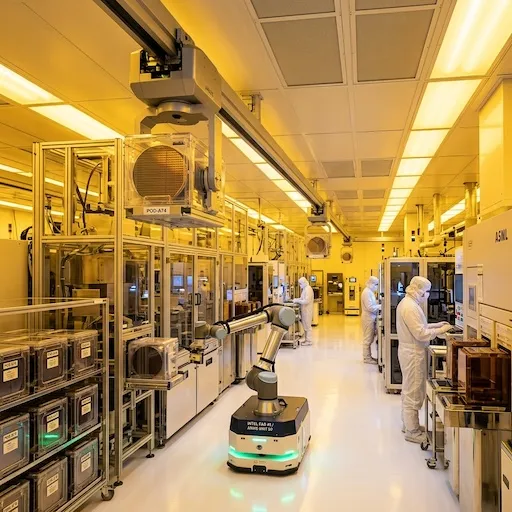
Advanced semiconductor fabrication requires printing circuit features only a few nanometers wide onto silicon wafers. Leading global foundries (TSMC, Intel, Samsung) achieve this using Extreme Ultraviolet (EUV) lithography systems, which use short 13.5nm wavelengths to print complex features in a single exposure.
Due to strict international export controls, Chinese foundries like SMIC do not have access to EUV systems. Instead, they rely on mature Deep Ultraviolet (DUV) immersion systems running 193nm wavelengths. To print 7nm and 5nm features with DUV, foundries must employ complex multi-patterning techniques (SAQP - Self-Aligned Quadruple Patterning):
- Alignment Errors: Each additional exposure step increases the probability of overlay errors. A misalignment of even 1.5nm between silicon layers will cause functional circuit failures.
- Economic Mismatch: SAQP requires up to 4 times as many photomasks and exposure steps as EUV. This drastically increases wafer cycle times and tool wear, making the chips economically uncompetitive for commercial open-market sourcing.
Yield Rate and Capacity Comparison: TSMC vs. SMIC Nodes
Yield rate (the percentage of functional dies on a completed wafer) is the ultimate metric of fab efficiency. The table below compares the estimated yield rates, lithography technologies, and primary B2B applications of TSMC and SMIC advanced logic nodes in 2026:
| Node Designation | Primary Foundry | Lithography Method | Estimated Yield (Complex Logic) | Primary B2B Application |
|---|---|---|---|---|
| TSMC N7 (7nm) | TSMC (Taiwan/US) | EUV / DUV (Single-exposure) | 80% - 85% | Automotive ADAS, Medical Image Processors |
| SMIC N+2 (7nm) | SMIC (Shanghai) | DUV (Multi-patterning SAQP) | 40% - 55% | Domestic Industrial Control ASICs, Smart Energy Controllers |
| SMIC 5nm | SMIC (Shanghai) | DUV (Octuple-patterning SAOP) | < 30% (Experimental) | Experimental AI and High-performance computing |
Sourcing Implications for Industrial Control:
Many popular domestic microcontroller lines—such as Gigadevice GD32 families or WCH core chips—are fabricated on highly mature nodes (40nm to 110nm). These mature nodes do not require advanced lithography and enjoy exceptionally high yields (>95%). Sourcing these mature components represents zero technical yield risk in 2026. However, any B2B system transitioning to custom 7nm or 5nm logic ASICs must prepare for high wafer-level cost premiums and tight capacity allocations at Chinese fabs.
Mitigating Geopolitical Sourcing Risks for Industrial ASICs
To protect B2B manufacturing pipelines from export restrictions or sudden foundry shutdowns, procurement teams should adopt a proactive three-step risk mitigation framework:
- Strategic B2B Inventory Buffering: Maintain a minimum 6-month buffer of single-sourced ASICs and custom microcontrollers. Because custom logic cannot be easily cross-referenced, having a physical inventory cushion is the only way to survive temporary supply disruptions.
- Dual-Sourcing Wafer Allocation: When designing next-generation ASICs, require design-house partners to qualify the design on multiple foundry PDKs (Process Design Kits). Designing layout versions for both TSMC and a neutral regional alternative (such as GF or UMC) prevents single-point-of-failure vulnerabilities.
- Audit Sourced Inventory via Vetted Channels: Sourcing custom logic from independent channels requires strict decapsulation and visual parametric inspection to ensure the die topography matches original manufacturer specifications and date codes.
Conclusion
China’s advanced logic foundries are making steady technological progress in 2026, but are facing severe DUV lithography limits and low yield rates that raise production costs. By understanding the division between highly reliable, mature nodes and the high-risk, low-yield advanced nodes, B2B procurement managers can build robust, regionalized sourcing strategies that protect their industrial lines throughout 2026.
Frequently Asked Questions (FAQ)
What is the yield rate of SMIC's 7nm node in 2026?
SMIC's 7nm process yields are estimated to be between 40% and 55% for complex logic ASICs, limited by dry DUV multi-patterning lithography. This drives up cost and limits volume compared to TSMC N7 nodes.