Table of Contents
The AI Chip “Bubble”: Hoarding vs. Deployment
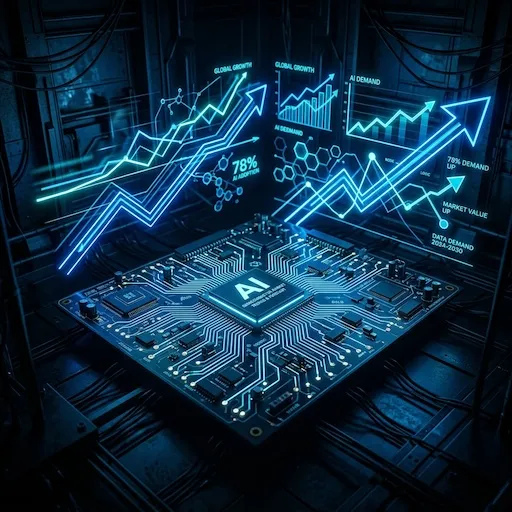
Throughout 2024 and 2025, hyperscalers and enterprises engaged in aggressive stockpiling of advanced compute GPUs and ASICs. This panic buying distorted demand signals across the entire semiconductor supply chain. By Q2 2026, the narrative has shifted from acquisition to deployment and ROI.
Market Correction Indicators
- Inventory Normalization: Secondary market prices for previous-generation AI accelerators have dropped as data centers optimize their existing clusters rather than expanding blindly.
- Shift to Custom Silicon: Major tech companies are increasingly deploying their own custom ARM-based processors, reducing the monopoly power of pure-play GPU vendors.
- Advanced Packaging Bottlenecks: The true constraint is no longer the silicon wafer, but the CoWoS (Chip-on-Wafer-on-Substrate) packaging capacity.
While the stock market may interpret these stabilization signals as a “bubble popping,” the physical supply chain sees it as a healthy normalization. The AI secular growth trend remains intact, but the panic premiums are evaporating.
The Ripple Effect on General-Purpose ICs
The most significant impact of the AI boom on the broader industrial supply chain has been the displacement of mature node production. Foundries reallocated massive capital and wafer starts toward high-margin AI compute.
This has created a sustained “quiet shortage” for commodity components:
- Power Management ICs (PMICs): Devices like the Texas Instruments
TPS54331DRcontinue to see erratic lead times as analog fabs remain underinvested. - Microcontrollers (MCUs): Automotive and industrial 32-bit MCUs from suppliers like Infineon and NXP are still subject to allocation, particularly for older flash-based variants.
| Component Category | Q2 2026 Supply Status | Pricing Trend |
|---|---|---|
| Advanced AI GPUs/ASICs | Normalizing (Lead times dropping) | Stabilizing (Premiums disappearing) |
| High-Bandwidth Memory (HBM) | Constrained | Increasing |
| Industrial 32-bit MCUs | Allocated / Spot Shortages | Flat to Slight Increase |
| Standard Logic & Discretes | Healthy Supply | Decreasing |
Sourcing Strategies for Q2 2026
Procurement teams must decouple their strategies for advanced nodes versus mature nodes.
For mature node components, rely on rigorous data analysis rather than broad market sentiment. Even if financial news reports a “semiconductor slowdown,” your specific BOM may still be at risk. Maintain relationships with trusted independent distributors who can leverage their global networks to locate verified stock for critical, under-the-radar components before they cause line down situations.
Frequently Asked Questions (FAQ)
Is the AI semiconductor market actually in a bubble in 2026?
How does the AI chip focus affect industrial component sourcing?
Are prices for standard electronic components dropping in Q2 2026?
Frequently Asked Questions (FAQ)
What are the main sourcing challenges for this semiconductor family in 2026?
The AI semiconductor market is experiencing a healthy bubble correction in Q2 2026. As lead times for high-end GPUs stabilize, focus has shifted to se...