
Table of Contents
- What Technical Specifications Make the Analog Devices AD5360BSTZ Vulnerable to High-Value Counterfeiting?
- Why Are High-Precision DACs in Critical Shortage Across Industrial and Telecom Sectors in 2026?
- What Are the Step-by-Step QA Protocols Needed to Guarantee 100% Authentic AD5360BSTZ Deliveries?
- 1. Optical Microscopy Inspection
- 2. Real-Time X-Ray Imaging
- 3. Acid Decapsulation Testing
- Secure Your Precision Analog Supply Chain
In the high-reliability industrial automation and telecom sectors of 2026, precision is not a luxury—it is a requirement. Digital-to-analog converters (DACs) are the essential bridge converting digital control signals into precise analog physical voltages. Among these, the Analog Devices AD5360BSTZ—a dense 16-channel, 16-bit DAC—is a critical component for optical network switches, automated test equipment (ATE), and medical MRI imaging arrays.
Due to the extreme technical specifications of these chips, any deviation in their performance will cause complete system instability. Sourcing the AD5360BSTZ during allocation cycles requires highly specialized quality assurance gates to prevent remarked or degraded components from entering your production line.
What Technical Specifications Make the Analog Devices AD5360BSTZ Vulnerable to High-Value Counterfeiting?
The AD5360BSTZ incorporates 16 independent 16-bit DACs into a single 56-lead LQFP package. The design features integrated user-programmable offset and gain adjustment registers, allowing engineers to calibrate drift across system lifetimes.
Because of the high complexity of the internal analog circuitry, manufacturing this device requires an extremely stable silicon process. The table below lists the core technical parameters that define the AD5360BSTZ:
| Specification Metric | AD5360BSTZ Technical Parameters | Engineering & QA Focus |
|---|---|---|
| Resolution and Channels | 16-Bit Resolution, 16 Channels | Requires sub-microvolt electrical testing to verify true 16-bit monotonic performance. |
| Integral Nonlinearity (INL) | ±4 LSB (Maximum) | The primary parameter that remarked or lower-grade chips fail to meet. |
| Output Range Options | Bipolar: 4x VREF (up to ±10V) | Requires dual high-voltage supply rails that demand high silicon thermal resilience. |
| Package Configuration | 56-Lead LQFP (8x8x1.4 mm) | Standard leaded profile, making it a target for physical lead-sanding and re-tinning. |
| Interface Type | SPI / QSPI / MICROWIRE / DSP Compatible | Enables high-speed serial communication up to 50 MHz for quick system refresh rates. |
A single AD5360BSTZ chip can cost upwards of $100 in volume. For counterfeiters, this represents a highly lucrative opportunity. They can purchase cheap, low-resolution 8-bit DACs in identical package outlines, sand down the original markings, and laser-remark them with the Analog Devices logo and AD5360BSTZ model markings. Mounting these fake components can lead to system drift, calibration failures, and costly field recalls.
Why Are High-Precision DACs in Critical Shortage Across Industrial and Telecom Sectors in 2026?
Sourcing precision analog components remains a difficult process in 2026. The key factors driving this shortage are:
- Highly Specialized Analog Processing: Unlike standard logic chips that scale down to tiny nodes, precision DACs rely on thick-gate, high-voltage silicon processes. Foundries are not expanding these mature mixed-signal lines, leading to a permanent structural capacity bottleneck.
- Extreme Telecommunication Rebound: The deployment of advanced private 5G networks and multi-wavelength optical transport nodes has created a massive demand spike for multi-channel DACs to handle beamforming and signal modulation.
- High-End Testing Requirements: Validating an AD5360BSTZ requires complex analog testing systems that check every single channel across its entire temperature range. Sourcing teams should note that testing bottlenecks at manufacturers are a primary driver of long lead times.
What Are the Step-by-Step QA Protocols Needed to Guarantee 100% Authentic AD5360BSTZ Deliveries?
When sourcing the AD5360BSTZ or other high-value analog ICs like the ADATE207BBPZ from independent distribution networks, buyers must require comprehensive testing protocols.
At SupplyICs, our zero-tolerance quality inspection framework ensures component authenticity:
1. Optical Microscopy Inspection
Our technicians perform intensive high-magnification visual audits of the plastic package body. We check for:
- Signs of sanding or chemical “blacktopping” coatings used to hide old markings.
- Inconsistent laser-engraving depth and typography deviations compared to original ADI fonts.
- Re-tinned package leads, lead oxidation, or residual board solder.
2. Real-Time X-Ray Imaging
We map the internal structures of the chip without damaging the component. X-ray diagnostics verify:
- Inherent consistency of lead-frame geometry, die placement, and wire bond patterns across the entire batch.
- Wire bond attachment integrity to ensure there are no microscopic breaks or lifted bonds that could fail under thermal stress.
3. Acid Decapsulation Testing
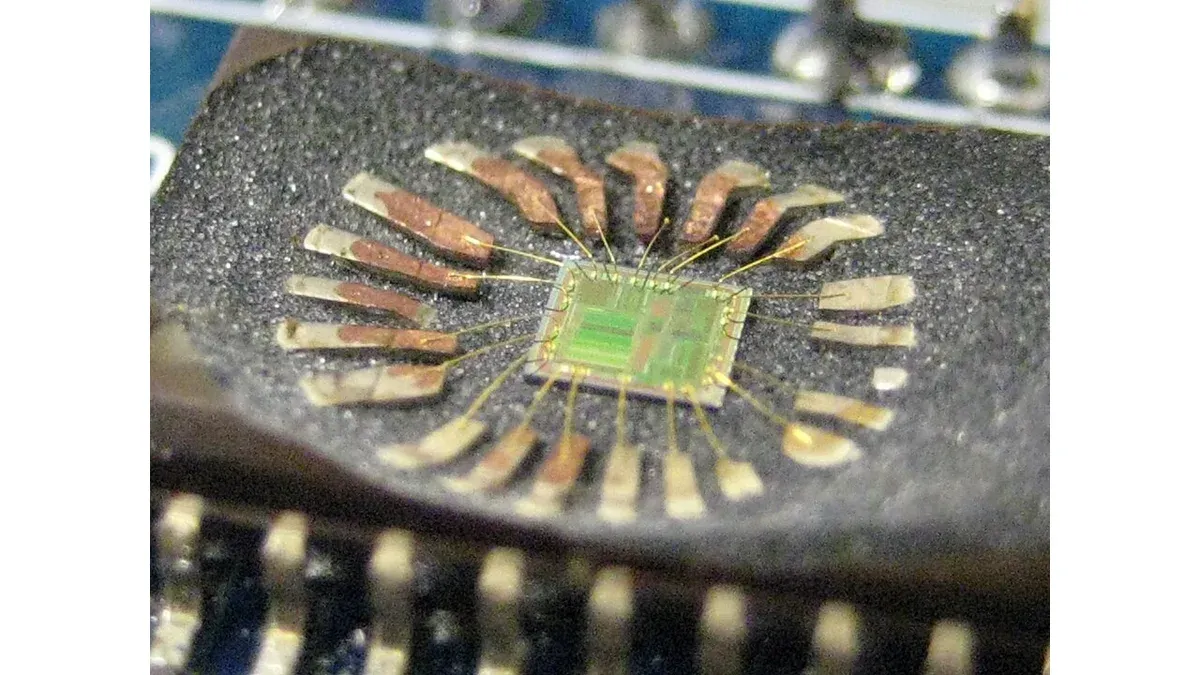
For high-risk batches, we perform chemical decapsulation on sample chips. Using precise mixtures of fuming nitric and sulfuric acids, we dissolve the protective plastic housing to expose the silicon die. Under high-powered microscopes, we verify:
- The presence of the official Analog Devices trademark and model registration codes printed directly on the silicon wafer.
- Exact die dimensions and alignment with the OEM’s layout designs.
Secure Your Precision Analog Supply Chain
Protecting your high-precision industrial systems from counterfeit chips is a critical business strategy. Sourcing teams must establish comprehensive quality gates, demand verified traceability documentation, and partner with highly capable distributors to ensure component integrity.
If your production schedule is threatened by an AD5360BSTZ shortage, or you need to authenticate high-value analog ICs, you can submit your RFQ through our BOM Upload Page or speak to a quality assurance expert on our SupplyICs Contact Page.
Frequently Asked Questions (FAQ)
Why are high-precision DACs like the AD5360BSTZ targeted by counterfeiters?
Because they are high-value, high-margin devices ($100+ per unit in volume) with long lead times, making them highly profitable targets for sophisticated remarking or recycling operations.
What are the primary indicators of a counterfeit AD5360BSTZ device?
Primary indicators include visual package sanding (blacktopping), inconsistent laser-etched font sizes, mismatched wire-bonding layouts in X-ray imaging, and lack of correct OEM die-marks under decapsulation.