Table of Contents
A Schottky rectifier replacement can offer a lower forward voltage and still create more heat in the application. During its reverse-biased interval, leakage produces another loss term. That term can become important at elevated temperature and reverse voltage.
A sourcing comparison should therefore preserve the waveform and thermal conditions alongside voltage, current and package. The buyer needs an approved operating-point comparison, not just a cross-reference with equal or larger headline ratings.
Why does reverse leakage matter when buying a Schottky replacement?
Reverse leakage dissipates power while the diode blocks voltage, and leakage generally increases with junction temperature. If the extra heat causes enough additional leakage, the thermal feedback can become unstable.
Nexperia’s discussion of Schottky thermal runaway describes the tradeoff between low forward drop, reverse loss, construction and package heat removal. It does not identify one universally best rectifier technology for every circuit.
For procurement, the consequence is straightforward: ask for leakage at the relevant reverse voltage and temperature. A room-temperature leakage figure cannot establish hot operating margin.
How should forward and reverse losses be compared?
Estimate each loss over its applicable part of the waveform, then evaluate the combined heat at the resulting operating temperature. Use the actual current and voltage waveform where a simple constant-value approximation is inadequate.
Consider two hypothetical candidates operating with 2 A during a 50% forward-conduction interval and 40 V during the remaining interval:
| Assumed parameter | Candidate A | Candidate B |
|---|---|---|
| Forward voltage at the relevant condition | 0.45 V | 0.55 V |
| Hot reverse leakage at 40 V | 8 mA | 1 mA |
| Approximate forward loss | 0.45 W | 0.55 W |
| Approximate reverse loss | 0.16 W | 0.02 W |
| Sum of these two terms | 0.61 W | 0.57 W |
The numbers are illustrative, not specifications of actual products. They show how a 0.10 W forward-loss advantage can be offset by reverse leakage. Switching-related losses and waveform details are omitted from this simple example.
Taiwan Semiconductor’s thermal-runaway paper likewise treats leakage as a necessary second-source comparison input. The operating point must be reevaluated as temperature changes; it is not enough to insert an arbitrary hot leakage value once.
Which thermal conditions must a supplier comparison retain?
Retain the mounting condition, available copper or heat sink, ambient or case temperature, package thermal data and the method used to estimate junction temperature. A current rating measured with a controlled case temperature may not apply to an uncooled board.
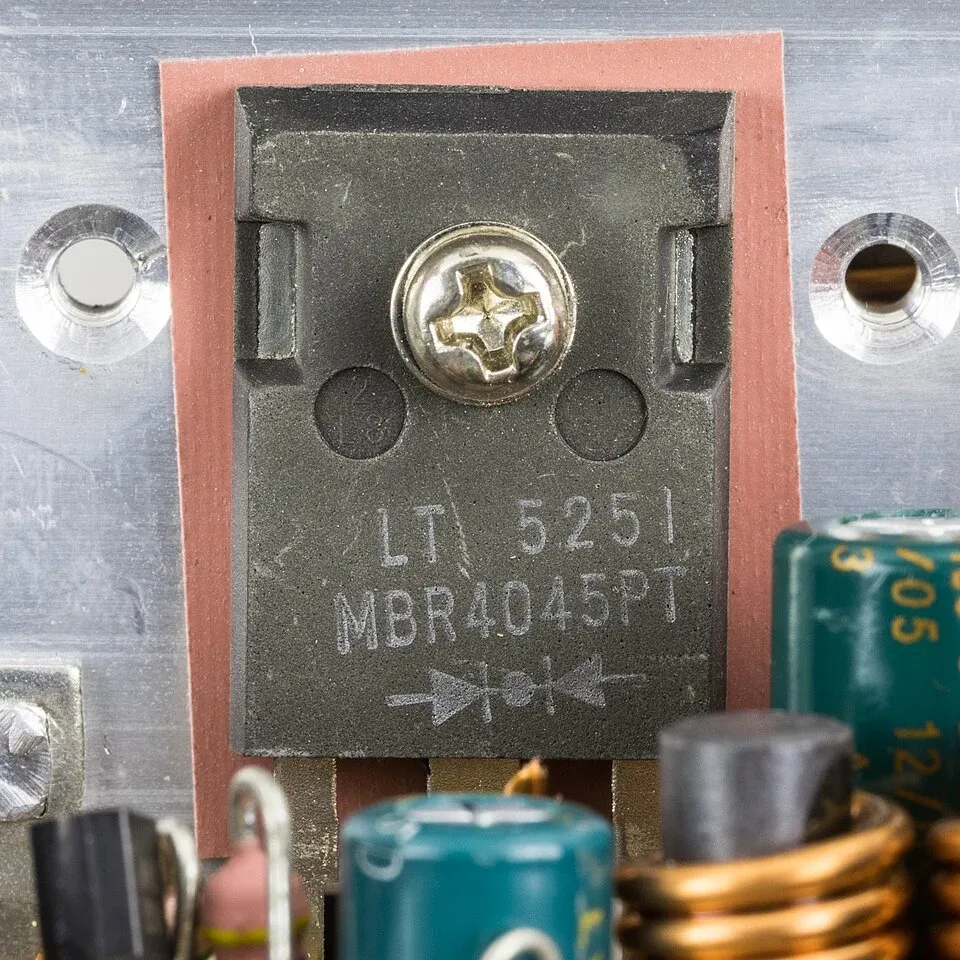
Pay attention to the full package drawing. Pad area, terminal geometry and an exposed heat-transfer surface can change the installed result. A smaller package with an attractive current rating may depend on a heat path the existing PCB does not provide.
If a thermal model uses junction-to-ambient resistance, confirm the board conditions behind it. If it uses a measured case temperature, use the appropriate thermal path and measurement location. Mixing those approaches can produce an apparently precise but invalid junction-temperature estimate.
Can a higher-voltage Schottky diode be treated as an upgrade?
A higher reverse-voltage rating can create additional voltage margin, but it may change forward drop, leakage, capacitance and package choice. Approve it against the application rather than assuming that one larger rating improves every relevant behavior.
For a switching converter, compare the reverse waveform including overshoot and ringing. For a blocking application, examine long periods at reverse voltage and high ambient temperature. The limiting case can differ even when both circuits use the same nominal supply voltage.
A rectifier comparison is also distinct from a TVS clamping assessment. The devices are purchased for different functions and should not be selected from an undifferentiated “diode” replacement list.
Turn the engineering result into a controlled purchase
Record the exact original and candidate codes, electrical connection, thermal installation, calculated assumptions and hardware observations. Include startup, normal load, hot blocking and any required transient conditions.
The supplier’s offer should identify deviations in package, grade, packing and lot requirements. If the candidate needs more copper, a different heat sink or a revised operating limit, it is an approved design change rather than an unconditional drop-in substitute.
That distinction lets procurement compare available offers without losing the conditions that made the replacement acceptable.
Frequently Asked Questions (FAQ)
Can a silicon PN diode replace a Schottky diode with the same voltage and current ratings?
Treat that as a technology change. Forward drop, reverse recovery, capacitance and thermal behavior can differ enough to require a new circuit assessment.
Is the current printed in a diode catalog an unconditional continuous rating?
No. It is tied to specified thermal and mounting conditions. Compare the rating's case, lead or ambient conditions with the actual installation.
Should both diodes in a dual package be considered independently?
Check their electrical connection and shared thermal path. Power dissipated in one section can raise the temperature of the other, so separate catalog current values do not establish simultaneous capability.