
Table of Contents
- How do you calculate the minimum CTR an optocoupler circuit needs?
- Why should optocoupler temperature and aging allowances be separated?
- Isolation ratings require their own comparison
- What switching limits can rule out an optocoupler alternate?
- Put the lifetime assumptions in the approved-source record
An optocoupler replacement must still switch the receiving circuit near the end of its service life. Matching package, pinout, and an attractive typical current transfer ratio (CTR) does not establish that result. The useful specification starts at the receiver threshold and works backward through CTR, LED current, temperature, aging, and resistor tolerances.
This article treats phototransistor optocouplers used for signal transfer. Gate-drive optocouplers, photovoltaic couplers, linear optocouplers, and safety-certified isolation systems need additional parameters.
How do you calculate the minimum CTR an optocoupler circuit needs?
Divide the receiver’s required collector current by the minimum available LED current, then express the ratio as a percentage to obtain the minimum current transfer ratio (CTR) before temperature and aging allowances. The receiver requirement must include pull-up tolerance, leakage, and logic margin; the LED-current minimum must include supply, resistor, and forward-voltage tolerances.
Compare that requirement with the guaranteed CTR range of the purchased grade at the intended LED current, collector-emitter voltage, and temperature. A rank code identifies a range under specified test conditions, not a universal gain guarantee.
Vishay’s guide to reading an optocoupler datasheet, accessed September 24, 2026, shows why CTR bin, test current, and operating point must be read together. A minimum CTR specified at 5 mA does not automatically apply at 0.5 mA.
Preserve a maximum CTR check as well. A deeply saturated phototransistor can turn off more slowly, so substituting the highest available grade can hurt timing in a circuit designed for a lower bin.
Why should optocoupler temperature and aging allowances be separated?
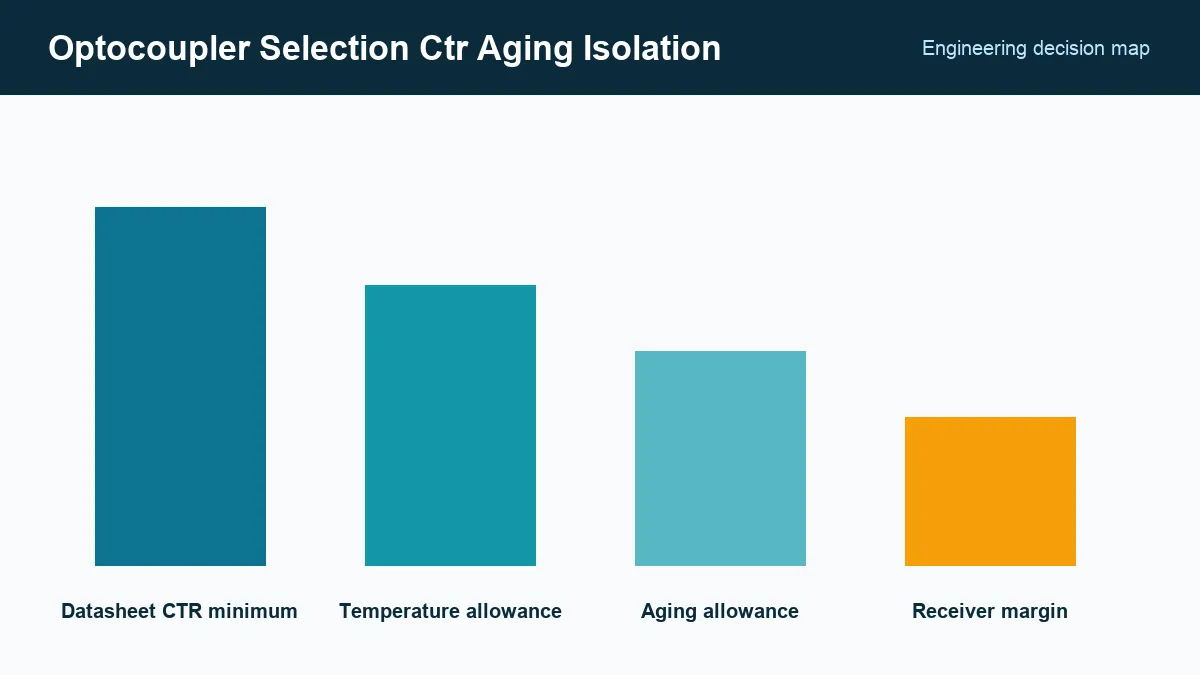
Temperature changes the optocoupler’s operating gain, while LED aging reduces optical output over service time. Evaluate both effects under the candidate manufacturer’s stated conditions so one allowance does not hide or double-count the other. Relevant lifetime inputs include LED current density, junction temperature, duty cycle, technology, and hours of operation.
Renesas’ optocoupler lifetime application note, accessed September 24, 2026, models CTR degradation using operating conditions rather than one universal aging factor. Use that type of manufacturer model for the candidate device and document the assumptions.
A transparent end-of-life budget can use this order:
- Begin with the guaranteed CTR minimum for the purchased rank at the relevant input current.
- Apply the manufacturer’s temperature behavior at the worst credible junction or ambient condition.
- Apply the supported lifetime degradation for the intended current, duty cycle, and hours.
- Compare the remaining collector current with the receiver threshold plus design margin.
Do not multiply unrelated “safety factors” until the part fails on paper. Each allowance should represent a defined uncertainty or degradation mechanism.
Isolation ratings require their own comparison
CTR equivalence cannot compensate for an inadequate insulation system. Compare the candidate’s certification, insulation classification, creepage and clearance, material group, transient rating, repetitive peak voltage, and working-voltage conditions required by the end equipment.
A dielectric withstand value is commonly a short production or qualification test. It is not permission to apply that voltage continuously. Pollution degree, altitude, overvoltage category, and the governing product standard may change the required spacing and rating.

Record the exact agency file or certificate scope if certification matters. Similar family names can cover different packages, options, or insulation categories.
What switching limits can rule out an optocoupler alternate?
Propagation delay, rise and fall time, storage time, saturation voltage, leakage, and collector capacitance can rule out an optocoupler alternate that passes the DC CTR check. Evaluate them at the actual LED drive and receiver load: a large pull-up resistance slows an output edge, and deeper transistor saturation can lengthen turn-off.
Bench validation should cover minimum and maximum LED drive, supply limits, temperature conditions important to the product, and realistic receiver impedance. Observe both logic margin and timing. If the optocoupler participates in feedback control, evaluate loop response rather than treating it as a digital isolator.
For high common-mode transient environments or faster interfaces, a digital isolator may be a different architecture, but it is not a pin-compatible optocoupler substitution.
Put the lifetime assumptions in the approved-source record
The approved record should include manufacturer and full ordering code, CTR rank, test conditions, LED current range, receiver threshold, end-of-life margin, timing limits, temperature grade, package, isolation certification, and lifecycle status.
When a supplier offers a different rank or suffix, require a datasheet-level comparison before accepting samples. Lot inspection can verify label, package, and marking consistency, but it cannot establish lifetime CTR without the manufacturer’s technology data and the application’s stress profile. Procurement can then distinguish a true qualified alternate from a part that only shares the footprint.
Frequently Asked Questions (FAQ)
Is a higher optocoupler CTR grade always a safer replacement?
No. A higher CTR range can change transistor saturation and turn-off behavior, while the application may also have maximum-current or timing limits. Compare both minimum and maximum CTR under the intended LED current and temperature.
Can isolation test voltage be used as continuous working voltage?
No. A short-duration dielectric test rating and the permitted repetitive or working voltage describe different stresses. Use the applicable safety certification, insulation category, creepage, clearance, and working-voltage data.
How should optocoupler aging be handled in a purchase specification?
State the required end-of-life output margin and the assumed LED current, temperature, duty cycle, and service time. Then use manufacturer degradation data for the specific technology and grade rather than a generic percentage.