Table of Contents
- What Makes the Cyclone V 5CEFA9F23I7N a Permanent Fixture in Industrial Design?
- Why Are Mature-Node FPGAs Still Experiencing Shortages in 2026?
- How Can Sourcing Teams Navigate the 5CEFA9F23I7N Sourcing Bottleneck?
- 1. Evaluate Grade-Migration Strategies
- 2. Leverage Vetted Independent Distribution
- 3. Implement Strict Anti-Counterfeit Audits
- How to Secure Your Long-Term FPGA Pipeline
In mid-2026, many industrial and telecommunication manufacturing lines are running into unexpected headwinds. While high-end AI GPU shortfalls capture global news cycles, procurement departments face a quieter but equally disruptive crisis: securing low-power, high-reliability legacy programmable logic. Specifically, the Intel Altera Cyclone V family—powering thousands of industrial automation, medical imaging, and military control systems—is experiencing extreme supply volatility. Sourcing a specific part number like the 5CEFA9F23I7N has become a high-stakes challenge for purchasing directors.
Managing these deficits requires a combination of deep technical insight, strict quality assurance, and global inventory visibility. This guide provides a strategic analysis of the Cyclone V sourcing landscape to help you prevent line-down events.
What Makes the Cyclone V 5CEFA9F23I7N a Permanent Fixture in Industrial Design?
To understand why this specific chip remains in high demand, we must look at its architectural parameters. The 5CEFA9F23I7N is built on a mature 28nm low-power (28LP) process, combining dense logic blocks with low static power dissipation. It provides a balanced array of logic elements, embedded multipliers, and digital signal processing (DSP) blocks that are perfect for industrial control algorithms.
Unlike modern, high-power FPGAs designed for data centers, the Cyclone V does not require complex thermal cooling solutions or multi-phase power delivery networks. The table below details the core technical specifications of this highly sought-after device:
| Specification Metric | 5CEFA9F23I7N Parameter Value | Engineering Significance |
|---|---|---|
| Logic Elements (LE) | 301,000 LEs | Provides ample programmable fabric for multi-axis motor controllers and video interfaces. |
| Internal Memory Blocks | 13,917 Kb (M10K Blocks) | Enables high-speed localized data buffering without relying on external SRAM. |
| FineLine BGA Package (F23) | 484-Pin FBGA (23x23 mm) | A compact footprint that accommodates 224 user-defined I/O pins with 0.8mm pitch. |
| Temperature Grade (I7) | Industrial: -40°C to 100°C | Essential for outdoor grid controllers, automotive manufacturing lines, and medical suites. |
| Speed Grade | 7 (Mid-Range Speed) | Balances high timing performance with thermal efficiency and lower system cost. |
Because industrial lifecycles typically span 10 to 15 years, migrating a legacy system away from the Cyclone V is a costly process. Hardware teams must re-design multi-layer PCBs, rewrite VHDL or Verilog timing constraints, and go through expensive regulatory re-certification. Sourcing the original 5CEFA9F23I7N remains the most cost-effective path to keeping legacy assembly lines active in 2026.
Why Are Mature-Node FPGAs Still Experiencing Shortages in 2026?
The supply chain volatility of mature FPGAs is driven by semiconductor foundry economics. As detailed in the SEMI Fab Forecast, global foundries are investing over 80% of their capital expenditure (CAPEX) into advanced sub-7nm lithography to capture high-margin AI accelerator business.
Planar 28nm nodes are receiving minimal expansion funding. When foundries like TSMC or UMC run at maximum capacity, they prioritize high-volume automotive microcontrollers and consumer PMICs over lower-volume, specialized industrial FPGAs. This leaves Cyclone V chips susceptible to severe supply gaps during demand rebounds.
Additionally, consolidated raw wafer supplies and specialized packaging materials (such as high-Tg halogen-free BGA substrates) are facing logistics bottlenecks, pushing franchised lead times for Intel Altera FPGAs beyond 36 weeks.
How Can Sourcing Teams Navigate the 5CEFA9F23I7N Sourcing Bottleneck?
When franchised distribution channels issue long allocation delays, procurement managers must adopt immediate defense strategies to protect their manufacturing pipeline:
1. Evaluate Grade-Migration Strategies
If the industrial-grade 5CEFA9F23I7N (rated for -40°C to 100°C) is completely out of stock, consult your engineering team about migrating to the commercial-grade 5CEFA9F23C7N (rated for 0°C to 85°C). While this requires an environmental waiver, the devices share identical electrical characteristics, pin layouts, and programming binaries. For indoor industrial systems or benign clinical medical devices, this temporary substitution can bypass a line-down crisis.
2. Leverage Vetted Independent Distribution
Independent distributors act as a vital bridge during supply shortages. Vetted distributors can source from excess OEM inventory buffers, contract manufacturing surpluses, and un-allocated global warehouse blocks. If you locate the 5CEFA9F23I7N in stock via independent networks, ensure you partner with a distributor that maintains high-level quality assurance capabilities.
3. Implement Strict Anti-Counterfeit Audits
The high market value of Cyclone V FPGAs makes them primary targets for sophisticated remarking operations. Sourcing from the open market requires a rigorous verification pipeline.
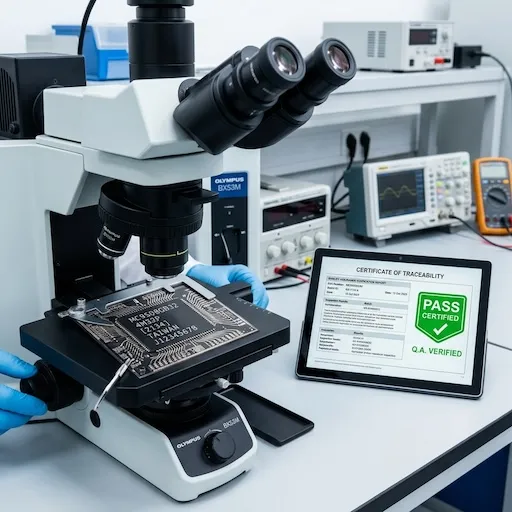
At SupplyICs, every high-value logic component passes through our zero-tolerance QA system:
- Visual Microscopic Audits: We inspect packaging materials, laser marking depth, pin planarity, and solder ball oxidation under high magnification.
- X-Ray Structural Analysis: We verify inner lead frames, die sizes, and wire bond layouts against verified golden samples.
- Micro-Decapsulation Testing: We physically remove the plastic package on random samples using chemical acids to inspect the silicon die, verifying the proprietary Altera trademark and layout revision marks on the silicon wafer.
How to Secure Your Long-Term FPGA Pipeline
The 2026 semiconductor market shows that reactive buying during shortages leads to high premiums and delivery delays. Sourcing teams must secure their pipeline by establishing rolling forecasts, qualifying alternative designs (such as the Cyclone 10 LP or Lattice ECP5), and building relationships with trusted supply chain partners.
If your production is facing immediate delays due to the 5CEFA9F23I7N or other Altera logic chips, you can submit your BOM directly through our BOM Upload Page or get in touch with our engineering team on the SupplyICs Contact Page to locate certified, traceable inventory.
Frequently Asked Questions (FAQ)
What are the main sourcing challenges for the Intel Altera 5CEFA9F23I7N in 2026?
Sourcing the 5CEFA9F23I7N is difficult due to mature-node 28nm capacity reallocation and extended factory lead times. Strategic sourcing requires date-code audits and verifying pin-compatible alternatives.
Is there a drop-in pin-compatible replacement for the 5CEFA9F23I7N?
Yes, the commercial-grade 5CEFA9F23C7N has the same footprint and pinout but operates in a narrower temperature range (0°C to 85°C) compared to the industrial-grade 'I7N' (-40°C to 100°C).